{Monolith}
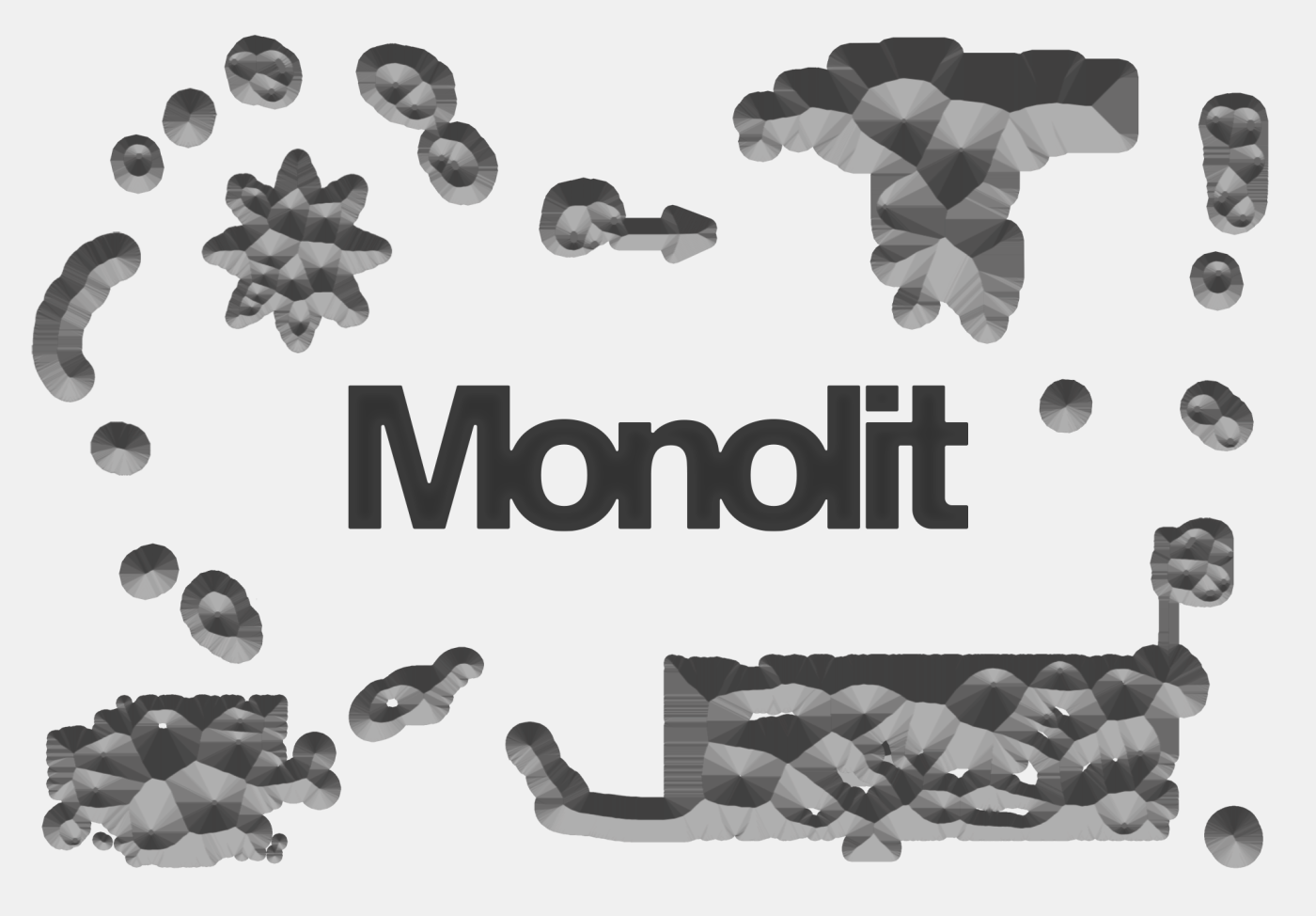
The {Monolith} cycle explores technologies and materials — from integrated circuits to plastic polymers — that may become lasting relics of human activity. We ask questions about the “deep matter” of future epochs: what will endure as a geological‑technological layer of the Earth, and into what forms the remnants of our civilization might transform. Here, we understand the monolith both as a solid block of rock and as a coherent technological architecture — a symbol of the unknown core of a future archive, a carrier of information, and a material record of human activity.
About the format
The gallery becomes an open laboratory in which the creative process is just as important as its material outcome. We are interested in the visible, tangible relationship between artistic work and scientific activity, as well as the possibility of integrating such collaborations into more sustainable artistic production, based on biological and regenerative materials. The installation develops in front of the audience, and the space itself begins to function as an experimental environment.
The {Monolith} cycle also searches for quasi‑exhibition formats in which the institution does not simply present objects, but performs its own structure — a network of relations, processes, and collaborations. We think of it as an organism co‑created through flows of knowledge, matter, and technology. This mode of working echoes contemporary machine‑learning practices, where meaning emerges from iteration, relationships, and the continuous updating of data. We treat the exhibition space in a similar way: as an environment that is constantly changing, responding, and inviting the audience to experience not a finished artwork, but an ongoing research process.


