Flows
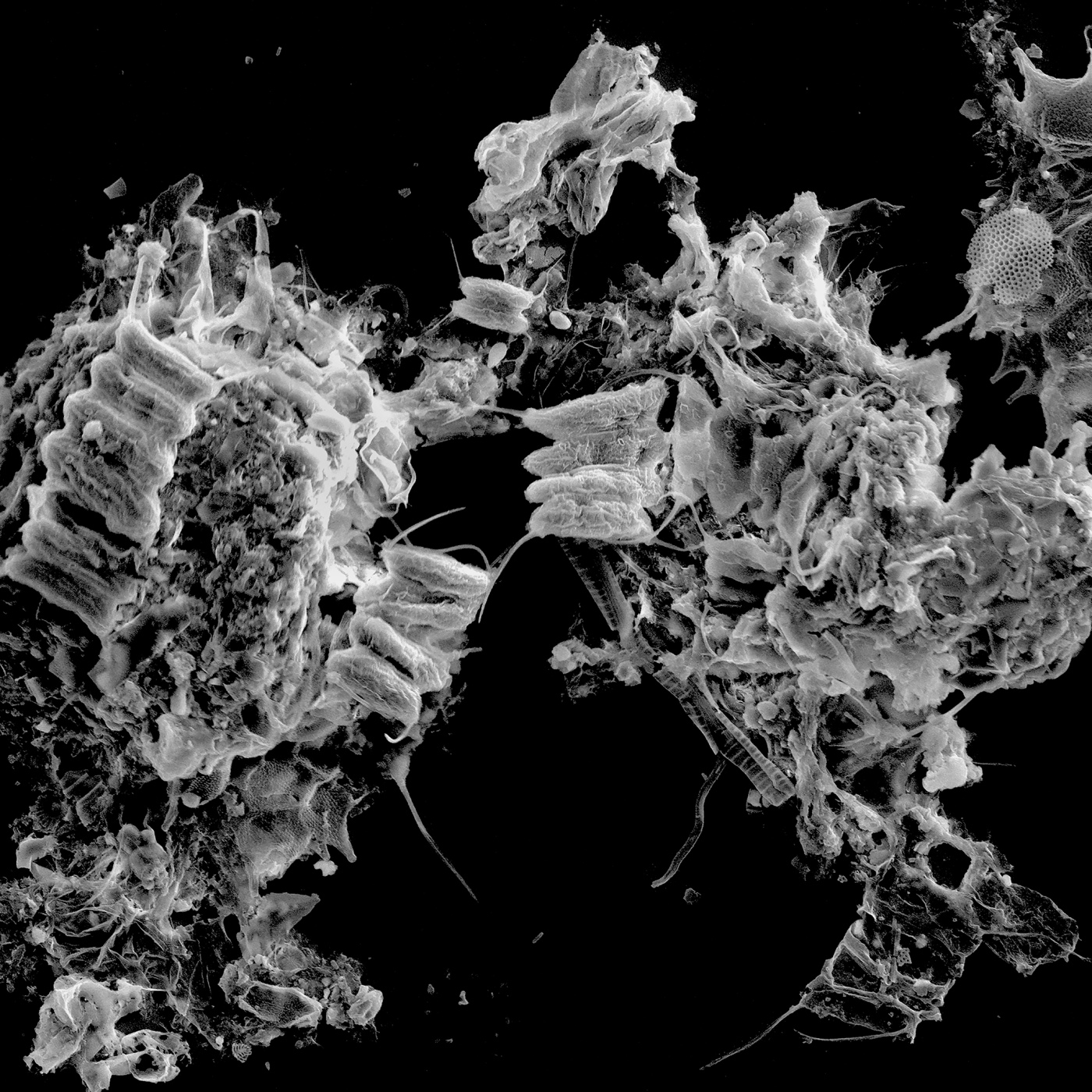

Flows is the first installment of the Monolith cycle — a search for new post‑human materials and, at the same time, a time‑based exhibition by Kuba Bąkowski. At the Ujazdowski Castle Centre, the artist creates a kind of bio‑laboratory. The central element of the project is a bioreactor transformed into a capillary, kinetic form with an ambiguous status — at once a sculpture and a research device.
The starting point for the work is research carried out together with Prof. Joanna Kargul, head of the Laboratory of Photosynthesis and Solar Fuels at the Centre of New Technologies, University of Warsaw. The project uses unicellular algae, including extremophilic red algae Cyanidioschyzon merolae — representatives of an early evolutionary lineage of the Rhodophyta phylum — as well as green algae from the Chlorophyta phylum, widely used as model organisms in studies of phototaxis. Their ability to respond to light and to spontaneously move within the water column becomes both material and creative medium, as well as a site for examining relationships between living organisms, technology, and their environment.
The project investigates the potential of algae as living matter — not only dynamic, adaptive, and capable of functioning under changing environmental conditions, but also as an alternative, autonomous regenerative system. In this sense, algae allow for speculative visions of the future — of a world without humans or after humans. Their metabolic, photosynthetic, and transformative capacities make it possible to imagine scenarios in which biological matter takes over structural, energetic, and processing roles within a post‑human landscape.
The resulting bio‑sculpture functions as a prototype habitat for algal colonies. Its elements respond to light intensity, creating a dynamic system of energy flows between biological matter, control algorithms, and the architecture of the object. In this way, the artist continues his earlier explorations of bio‑hybrids — sculptures whose movement and behaviour result from the interplay between metabolic processes and digital systems.
The project also opens a space for broader reflection on the persistence of matter in geological and biological time. As part of the accompanying programme, performative lectures and meetings are planned, during which researchers will discuss, among other topics, microorganisms inhabiting Warsaw’s water reservoirs, the lives of extremophiles (organisms capable of thriving in extreme environmental conditions) in hot volcanic habitats, and bacteria that oxidize iron into brittle rust. These are the very microorganisms responsible for the slow, inevitable degradation of metal structures such as the wreck of the RMS Titanic. The ship’s structure is currently undergoing colonization by communities of bacteria that transform steel into fragile ore. Within a few decades, the wreck will be almost entirely absorbed into the natural cycle of matter, demonstrating how human‑made objects may transform into new geological‑biological forms.



