Sumoo
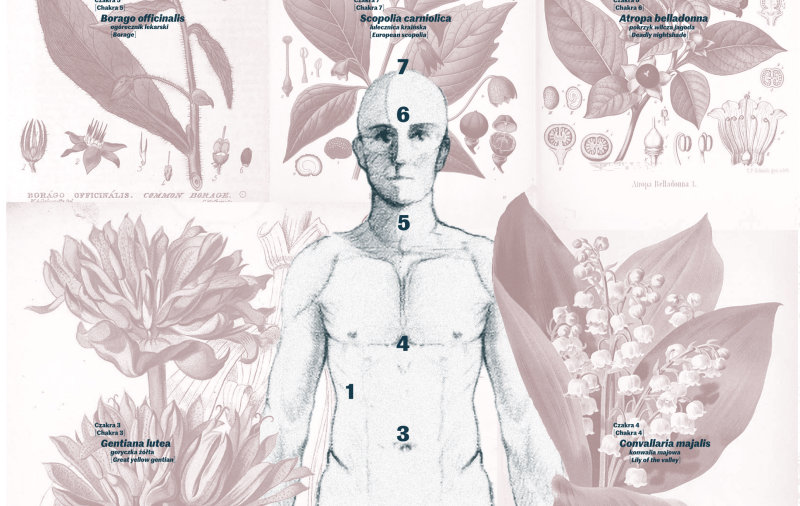
We researched native Polish plants that would fit our criteria of medicinal plants that interact with seven different segments in the body and with our entirety as human beings. The research was exciting, rewarding, and enriching. We were hoping to include all the plants we had discovered and listed in the publication as part of our installation at Ujazdowski. However, due to the specific dates of the exhibition and the constraints of the space at the gallery, we were not able to use the "ultimate plant selection" yielded by our search, so we resolved not to force or invest in growing the plants. Instead, we chose to include other plants that do not entirely fit with our criteria as medicinal and native, but which would still meet the aims and would adapt perfectly at the time of the exhibition and with the space of the gallery. We know that nature is rich beyond grasp, and that many plants around the world can very similarly interact with our being the same way that our Polish plants do.
Chakra 1 / Red
Tropaeolum majus – Nasturtium
Plant info:
Native to South America, but for centuries in Poland wildly grown in gardens and on balconies. Depending on the variety, flower color ranges from light yellow, through orange, to dark red.
Medicinal properties:
Among others, it is a diuretic, anti-fungal, and anti-bacterial, used for kidney problems.
Uses:
Its flowers have a sweet-hot taste, and both flowers and leaves are edible and rich in vitamin C. Pickled, unripe fruit can be a tasty additive to various dishes - used in the place of capers. The dried seeds are hot and used as a black pepper replacement. Nasturtium is very attractive to aphids, playing the role of an aphid repellent for other plants.
Chakra 2 / Orange
Calendula officinalis – Pot marigold
Plant info:
It is probably native to Southern Europe, but its long cultivation makes it difficult to determine its origin. In Poland, it has been naturalised. It flowers from the end of May to the end of September. It has two flower types: strap-shaped ray flowers attracting pollinators and circular-shaped disc flowers (bearing sexual parts).
Medicinal properties:
For stomach and intestine problems, menstrual disorders, wound healing, anti-inflammatory, and anti-bacterial.
Uses:
A common ornamental in the gardens, cultivated as a medicinal plant. Its inflorescences are edible. In Polish ethnoveterinary, it was used to help cleanse a cow's uterus after delivery.
Chakra 3 / Yellow
Gentiana lutea – Great yellow gentian
Plant info:
A mountainous species, native to Central, Eastern, and Southern Europe. There is a native population in the Eastern Carpathians, but it is not noted in Poland. It used to be grown on Babia Góra. The Polish name reflects the bitter taste of its roots. For germination, its seeds need cold stratification, leaving it endangered by global warming.
Medicinal properties:
It stimulates the digestive system and appetite, is anti-inflammatory, and used for wound healing.
Uses:
The root is an important ingredient of species digestivae (herbs stimulating the digestive system). It is used in bitters and liquor production, e.g., Gentian (Enzian liquor). The fermented roots have a stronger smell and are less bitter.
Chakra 4 / Green
Convallaria majalis – Lily-of-the-valley
Plant info:
Native to Poland, it is often found in deciduous and mixed forests. Although its flowers are a symbol of innocence, it can be deadly poisonous - children can die even after drinking water from a vase with its flowers. Its rhizomes may grow in one place for decades. The fruits ripen in September/October, and then minerals are moved from the aboveground parts to the underground.
Medicinal properties:
Cardiac diseases and high blood pressure.
Uses:
Since XII century, it has been used as an ornamental. In bridal bouquets, it is a symbol of purity and modesty. Used for perfume making. Dried flowers were added to snuff.
Chakra 5 / Blue
Borago officinalis – Borage
Plant info:
Naturalised in Poland, it grows in meadows, with its blue flowers catching the eye. The Polish name is derived from its cucumber-like taste.
Medicinal properties:
A mild diuretic, a mild anti-inflammatory and sedative; in folk tradition, it is used, among other things, for mucosal healing in the mouth and for respiratory disorders.
Uses:
Associated with health, which can be traced in its Latin name, but not proven by modern Western pharmacognosy. Its edible leaves and flowers are very tasty in salads. According to the old pharmacopoeias, flowers used in salads drive away sorrow and increase the joy of the mind. In the garden, strawberries respond well to the nearby presence of borage.
Chakra 6 / Indigo
Atropa belladonna – Deadly nightshade
Plant info:
Native to Poland. It may grow for several years in one locality, forming thickets, then it may vanish from this place altogether and start to grow in a different place. The whole plant, including the shiny black berries, is deadly poisonous.
Medicinal properties:
It acts as an anticholinergic. Used in ophthalmologic diagnostics to dilate the pupils (atropine).
Uses:
Chemical substances present in the plant (flying ointment ingredient), when absorbed through mucous membranes, induce hallucinations and the sensation of flight. It was claimed as the source of the depictions of witches flying naked on broomsticks. Atropos (coming from the plant's Latin name) is the name of one of the Three Fates, cutting the thread of life.
Chakra 7 / Magenta
Scopolia carniolica – European scopolia
Plant info:
It is rare and protected in Poland, growing in the shady, broadleaved forests of the Carpathian Mountains, in the Roztocze Upland and Sandomierz Basin in the remains of human settlements. It flowers in April and May, turning dormant in summer till the next spring.
Medicinal properties:
Diaphoretic and antiemetic, used in curing bipolar depression. It is deadly poisonous when overdosed. Contains scopolamine and atropine.
Uses:
Witches herb - Boykos and Lemkos used it as a hallucinogenic and soporific. Formerly used in anesthesia, but it too often caused death. Its use may lead to hepatic necrosis. Planted as an ornamental.