Anna Pajęcka
Anna Pajęcka
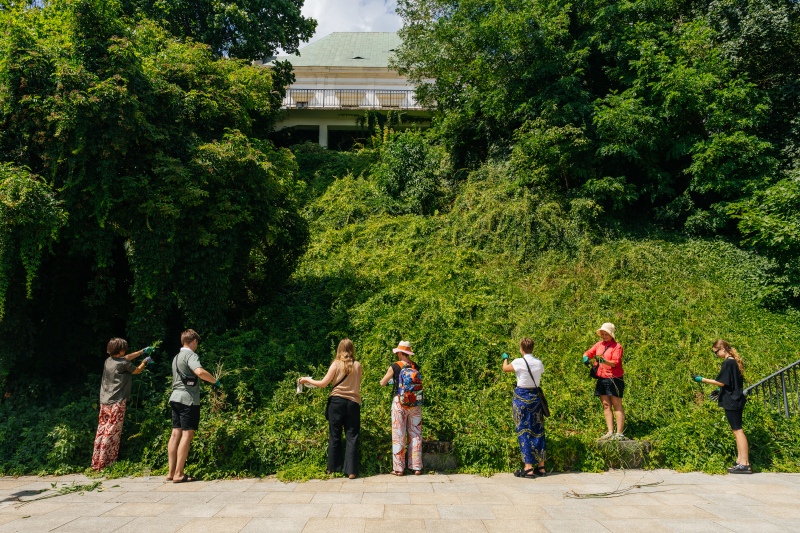
When I began a series of conversations with the artists-in-residence of the Common Field programme, I had a few initial insights and intuitions – and certainly a great many questions. I knew that the concept of “community”, which I would encounter over the coming weeks, would prove different each time. I also anticipated critical voices: those alert to the dangers of false communities, or communities that are too restrictive. And the “field” itself? It is a space with many meanings: at times something that may be appropriated, at others a place that can accommodate everything; it may even become a safe enclave that no one is allowed to enter. When I think of a field, I see rather a whole, a complete area. On the most practical level, the common field was simply the institution and Ujazdowski Park: the green space surrounding the Castle and, in particular, the embankment (at the bottom of which I live and which I once associated mainly with a difficult uphill climb every time I wanted to go “into town”) that, over the course of several conversations, revealed itself to be a rather unique area. The artists-in-residence were immersed in “green” topics in various ways – ecology, gardening practices, urban green spaces – and these themes form the main axis of Common Field.
However, after the initial conversations, this axis began to twist in a number of directions. I realised that, in the context of this residency, the field resembled more a graph: an arrangement of interlocking areas – intertwining, overlapping – to which each of residents added their own node, producing a map as blurred and wild as the Vistula River in Zakole Wawerskie. These diverse areas drawn on my imaginary graph are the sensitivities, perspectives and themes that the artists pursued during their residencies. Several of them were recurring. Most often: relationships. Over the past two months, I have probably heard this word more frequently than in my entire life – and not as an empty term, but as a narrative of how relationships are formed, what is experienced among people and non-people, and what can be done together. Maksud Ali Mondal spoke about relationships as coexistence. Annelotte Lammertse put it more bluntly: “It’s all about relationships.” Gosia Kępa is interested in relationships with people, nature and the environment, but also with herself. The Zakole collective worked on relationships within the group – on how to cooperate, when a reset is needed, or simply how to shape structured conditions for working together. Anka Wandzel told me that the residency gave her, above all, space for herself. We talked about care and equality in caring relationships.
The “common field” also turned out to be a laboratory for the creative process – a place where it is possible to slow down and think about how to work: with oneself and with others. Critical reflection on various fields appeared here, exactly as I had imagined. With Anka Wandzel we returned to this in the context of boundaries: what we consent to in our relationships with other people and institutions, where the comfort zone ends and where negotiation must begin. With the GALAS collective, we talked about the concept of “hospitality” – how the power dynamic between host and guest is established, and how language can shape political reality.
The audience was likewise tested as a form of shared participation. Most of the residencies involved including others in joint activities, questioning the role of the audience as a passive recipient of visual arts. Alicja Czyczel of the SQUIR collective said: “The audience has agency and it is up to them how they respond to the invitation encoded in the format we propose and what they take from it for themselves.” When I asked representatives of the collective about the deconstruction of the audience format in their extensive activities, they emphasised the importance of the participants’ comfort zones: their individuality, separateness and their right to refuse, which must be respected. I thought then that, in my principal area of activity – theatre – quite a few people would really benefit from hearing this. The benefits of removing the pressure to participate – and to be together in general – surfaced frequently in conversations. Julia Ciunowicz was the first to mention it when I asked her about her “textile walks” around Ujazdowski Castle. Working with hands, the rhythm of weaving, repeating the same gesture side by side by several people – these things remove the awkwardness from the encounter. “It’s a relational catalyst, a bit like working together in the garden: it doesn’t burden you with ambition, it gives you a break, it organises your thoughts,” she said. I followed this thread: with Vlad and Taras of the GALAS collective, we found the same effect in simple activities in the kitchen; with the SAM Rozkwit collective – in working together in the soil; with Zuzanna Szymłowska – in walking.
Such moments of contact, when threads and links came together, appeared surprisingly often – sometimes in completely unexpected forms. Konrad Fleszar told me about “hacking” public spaces by creating sculptures that first arouse an aesthetic need – a desire to possess – and only later reveal their true function, as homes for non-human organisms. The SAM Rozkwit collective put this idea into practice by setting aside Czyżnia (“thicket”) – a section of Ujazdowski Park that is to live at its own pace, becoming a refuge for hedgehogs, birds and other species whose presence cannot be predicted. This is an example of a situation in which, despite the processual nature of the residency, a lasting – even long-lasting – trace of reflection on co-functioning is created. Ewelina Węgiel also became entangled in similar relationships between human and non-human actors. She is an artist I find hard to compare with anyone or anything else in Polish art – a true phenomenon. She enters into long, multi-year processes based on trust-building, exploring communities from within, and the result is a film. She explained to me that the language of film is, for her, an inclusive tool – one that is familiar and easily engages people. She also told me about a method she learned at university in Berlin that I would like to share here: in order to truly feel and get to know a place, you must spend at least four hours there. No writing, no recording – just sitting and observing. Only afterwards, in silence, do you write down what you have experienced.
While talking to the residents and observing their practices, I was struck by their openness – their orientation towards others, their building of worlds into which someone else may be invited. Whether it is advice on how to be in space from Ewelina Węgiel, the SQUIR ritual, Julia Ciunowicz’s joint weaving, GALAS’s cooking, or raking the soil with SAM Rozkwit it is also a shared attitude towards the world, towards others and – of course – towards art, because we remain within the framework of artistic practice.
During my conversation with Maksud Ali Mondal, I asked him – somewhat provocatively – whether he considered his art difficult. After all, he uses chemical processes, material transformation and concepts drawn from the world of science. He replied immediately – and truly convinced me – that language is simply language and his works grow out of everyday experience. “Even if the audience doesn’t follow every conceptual clue, when I say, ‘This is made from dandelions,’ it echoes their experiences: ‘I remember that plant.’ This shared memory is already a level of understanding, a connection.”
As I write this text, I am increasingly convinced that the relationships formed as part of Common Field are genuine. So often declared by my interlocutors as an important concept, they have gone beyond language and become a practice – an event. Irish artist Deirdre O’Mahony, together with Olga Zawadzka of the Zakole collective, travelled to Polesie and Suwalszczyzna to talk with Polish farmers. She is working on a Europe-wide project and meets representatives of rural communities in various contexts. She had long dreamed of coming to Poland. I asked her what reception she had encountered. She replied quite plainly: exclusively positive. Sometimes, simply being listened to – by someone who comes selflessly – is a new gesture for the locals, to which they respond with trust. Anca Bucur, who comes from Romania, told me about the similarities between Romania and Poland that she discovered while walking around Warsaw and establishing a relationship with the city.
In our conversations, I also tried to understand how the Common Field practices influence the institution and its contemporary role. I asked this question of virtually every one of my interlocutors. Their reflections on their stay at Ujazdowski Castle, the opportunity to work in the park, their collaboration with the Green Team and, more broadly, its very establishment, were uniformly enthusiastic. They confirmed my intuition that we are dealing with an “expanded” institution – one that goes a step beyond its exhibition function, understood as its primary role.
Conversations about the institution of the museum in general, and about the institution of art more broadly, showed me how much we need laboratories such as Common Field. They can offer an example of real cooperation between an institution and artists – a common field in which the institution tests itself: its capacities, its negotiations with the organiser, with the provisions of cultural policy, and also – let’s be honest – with reality and contemporary needs. For instance, how should one work with collectives if a contemporary art institution is structurally oriented towards individual artists? Organisation, budgeting – all of this, when working with collectives, requires new practices, which Ujazdowski has been testing for many years. A separate but important issue proved to be the conservation of works. I spoke with Julia Ciunowicz about “green” conservation, which seeks to move away from thinking of a work as a permanent object to be preserved “forever.” With Maksud Ali Mondal, we discussed abandoning the logic of the product altogether and creating in such a way that there is nothing to store – that art becomes a process, a relationship, a trace in memory and experience, not necessarily just another object in a warehouse.
As I try to bring it all together, I see Common Field not only as a residency programme but as a model. It is, on the one hand, fragile and still being tested, while on the other – remarkably concrete. It shows that an institution can become a participant in the process, not merely a venue for exhibitions. It can take risks, share resources and test its limits alongside artists, rather than simply demanding “ready results” from them. The relationships I have mentioned here so many times are not just between individuals. They also include the relationships between practice and infrastructure, between imagination and regulations, between what is written in the contract and what actually happens. The “common field” is a space where such tensions are not swept under the carpet, but become material for work.
I believe that something will remain from this experience for a long time – a tested shift in how we think about the institution. As a field that is neither closed nor fixed once and for all, but co-created. By artists, curators, technical staff, plants, hedgehogs, viewers and spectators, as well as by those who “just” come for a walk on the embankment or to weave together. And I feel that this is perhaps the most important effect of Common Field: showing that an art institution does not need to pretend to be neutral. It can acknowledge that it is also a relationship – and that the quality of this relationship determines whether it will be sustained, for whom, and for what purpose.