Deirdre O’Mahony
Anna Pajęcka: How would you briefly describe your artistic practice and the media you work with?
Deirdre O’Mahony: My artistic practice has developed over forty years, becoming increasingly concerned with the politics of land and landscape. The research I undertake for each project determines the processes I use to create an artwork that reflects where I am at any given moment.
There’s an Irish expression, “to cut your cloth according to measure.” That’s essentially what I do: I shape the outcome according to what I feel is required for each project. Over the years, this has included many media. Early on, I worked primarily with painting. Later, I began to draw on the history of land art, re-contextualising it for today and for the issues we now face around food security, biodiversity and, in particular, soil.
Increasingly, I use both film and sound to try to make these topics feel fresh again – to cut through the fatigue and numbness many people feel due to the constant anxiety surrounding climate change.
Was that your first artwork in Poland?
Yes. I met Marianna Dobkowska in Berlin while I was doing a screening with Konteksty during their weekend programme there. I had previously worked with Sebastian Cichocki through EVA International, and I really appreciated his openness and his approach to making work that gains new value within our current social, political, environmental and ecological conditions. We were very much on the same page.
Coming to Warsaw felt, in a way, like coming home. I felt very comfortable there, and very comfortable doing research, because there are so many common issues between Ireland and Poland. People often say our countries are similar, and I agree – including in how we handle questions around colonial legacies. The form these legacies take is different in Poland, but the emotional responses are very similar: a feeling of being “less than,” of being excluded or left behind. I encountered this particularly in my research with farmers in Poland.
Can you tell me more about your research here during the residency?
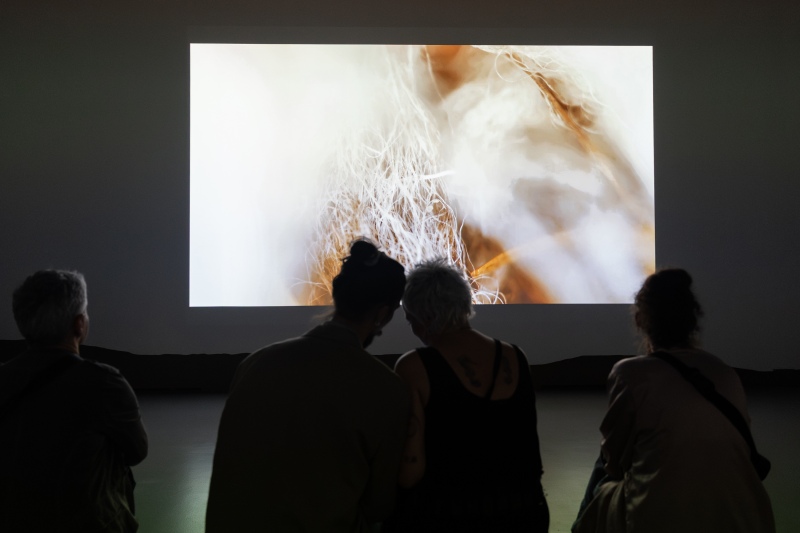
I felt incredibly privileged to be developing research for a new project I’m working on, which stems directly from The Quickening and from showing that film in rural places, often to mostly farming audiences. After one screening, I received a text message from a farmer saying, “This is the first thing I’ve seen that goes some way towards explaining what it is we’re dealing with.”
Again and again, when I meet farmers, I hear their despair at being framed as “the bad guys” in climate debates, and at the reductive public narratives around farming. I realised there was another job to be done: to draw on the potential of The Quickening and the subjects it deals with, to open up conversations with farmers – conversations that are not always easy.
So I began organising very intimate screenings of the film, sometimes in people’s kitchens, sometimes in community halls, and then recording their responses. I wanted to do this across Europe, because the same issues are affecting farmers – particularly small-scale farmers – everywhere. Within about a year, I was able to begin this research.
I had barely started thinking seriously about the idea when I met Marianna and began exchanging emails, because I was very keen to come to Poland. There are many Polish people working in Ireland, and the way they talk about land, land use, cultivation, cooking and potatoes revealed so many affinities.
Marianna offered me a month-long residency and, even better, she asked what I needed. She then arranged for Olga Roszkowska, a member of the Zakole collective, to work with me. Olga has excellent English and she drives, which is very important when researching agriculture in Poland.
We visited two regions: Suwalszczyzna and Polesie – both very beautiful and, in different ways, reminiscent of Ireland. We did extensive field research and visited twelve farms. We’ve been going through all the interviews since.
Olga has just been in Ireland on a residency run by the amazing sound artist Natalia Beylis, who will be working on the music for this new piece. The new work will be a suite of songs based on the words of farmers in each country. It will be performed at the European Union – either in or outside the European Parliament, depending on where I can get permission – and will channel the voices of small-scale farmers across Europe in order to engage politicians directly with the issues they are facing.
European policy often starts from very good intentions, but good intentions can make bad policy. Policies don’t always reflect realities on the ground. They also rely on each Member State to implement them. In Ireland, for example, regulations are often over-enforced due to fear of being penalised by Europe.
Our cheesemakers, for instance, face huge regulatory burdens and hurdles when making cheese. The exact same thing is happening in Poland, in Italy and in Spain. So one way to have these voices heard may be to use an aesthetic lens – to use whatever cultural capital comes with art to lever open a space where farmers’ voices can be heard.
Was it easy to build relationships with farmers, when you came to Poland? How did they react to your visits and questions?
Firstly, I was helped enormously by Olga, who already had connections in both regions. Having an interlocutor is incredibly important. But I should also say that I have never been refused by any farmer in any country – ever. Not because of any inherent charm, but because farmers recognise that I’m not coming in as an expert. I approach them as an artist, with some understanding of what they are experiencing. And they are desperate to communicate what they are dealing with.
In Poland, as in many European countries, the situation is politically charged. Right-wing parties are capitalising on the alienation and exclusion felt by many farmers. This is happening in Ireland too. So part of what I’m trying to do is create a space outside that politicised framework – a space for those who feel voiceless.
I can’t claim that I will change anything – that is beyond my capacity. But I can make the complexity visible and challenge the reductive arguments that dominate public debate. And I can offer a space in which people feel heard, even if only briefly.
My intention now is to work with all the recordings and draw out the key issues. Together with writers and with the composer Natalia Beylis, we will create six songs. We will perform them in each country, and I will invite each Minister of Agriculture to witness these performances.
It is important that it is an act of witnessing. I doubt they will come – but we will see.
If not, I’ll invite the next person down the chain. And if no one comes, the songs will be performed to the soil itself – and that too will be filmed. The outcomes of the project will include a performance at the European Parliament, a live performance in Ireland, and – funding permitting – an installation featuring all six songs in six languages (Irish included), forming the basis of a touring exhibition. I very much hope it will come to Poland.
I’d like to ask about some of your other work too – Eat Food Policy Feast in Dublin, which I saw online and found very compelling. Could you tell me something about this project? And do you think it is becoming easier to initiate conversations about policy and politics through art?
The Eat Food Policy Feast, and a second feast I organised around soil, were both choreographed very carefully to move participants away from their default positions. A politician will always speak from what they know; a farmer will do the same; so will a scientist. Bringing them together doesn’t automatically make it easier to speak openly, honestly, or to collectively reimagine other ways of doing things.
My aim with the feasts was to create a kind of rupture in those default behaviours. Every element – from the dinner service, which I made myself, to the cutlery engraved with researched quotations – was designed to prompt, unsettle and open up discussion. Each element of the food served was also carefully considered as a conversational trigger.
I also invited two artists to perform the role of what, in Irish, we call bean an tí – the archetypal matriarch who presides over the dinner table. This figure held the space, guided the flow of conversation and kept the atmosphere both hospitable and gently challenging.
There was also a kind of alter ego, or “fool,” who moved around the table rather than sitting at it intervening where required – if someone was dominating the conversation, or not participating. The dinner tables themselves were made from animal feeding troughs, filled with compost and covered with glass. Later, I re-used these troughs in exhibitions to hold research books or perform various functions – and eventually I returned them to farmers. So the whole process has a pleasing circularity.
For the piece, I embedded nine tiny microphones in potatoes placed on the tables. Everyone was informed that the conversations would be recorded, and nobody minded. In total, I had eighteen separate recordings – a nightmare to transcribe, but incredibly valuable.
The aim of the feast was to capture the full complexity of voices needed for The Quickening. The transcript is nearly 300 pages long and constitutes extremely important first-hand research. I’m currently speaking with a postdoctoral researcher who may use it in their work.
That slow, deliberate methodology meant that creating the dinner service alone took almost a year. But it also gave me a rare space for thinking through making, something I no longer do often. Most of my artistic life now happens behind a computer. While I was making the service, I listened to huge amounts of contemporary Irish folk music – and through that I discovered the musicians I later wanted to work with for The Quickening.
You mentioned The Quickening, which was shown in the Soil and Friends exhibition. Could you say something more about this work?
In a sense, the feasts were the path that led directly to The Quickening. They generated the material for the libretto, which took almost three months to shape. I worked on it with the writer Joanna Walsh and the curator-producer Georgina Jackson. Distilling everything to eleven pages was extremely difficult; there was so much we simply couldn’t include.
I began with the voices – and at the same time spent a year recording on farms and in landscapes with John Brennan, the sound recordist I work with regularly. We recorded the presence of the non-human inhabitants of the world who coexist with us. We were helped enormously by a farmer who manages her land for biodiversity, with a special focus on dung beetles. Through her, we gained an extraordinary palette of sounds. It was essential to me that the inhabitants of the soil had equal priority – that their voices were heard.
At the beginning you mentioned the importance of locality, and that Olga’s local knowledge was essential. What does the word “locality” mean to you in your artistic practice?
For me, locality is a conceptual focal point – a place where I can conduct deep research into the political dynamics that shape lived reality. It is a space where I bring my full attention and remain open to what that specific place has to say.
You also visited Zakole Wawerskie. What are your impressions of this place?
I told Olga that the Zakole wetland reminded me of similar pockets that exist in many cities – small areas that don’t fit the urban planning logic and somehow escape development pressure. I grew up in Limerick, where there was a very similar wetland space on the margins of the city, formed by the River Shannon. After I moved away, a road was built that cut it off, much like the ring roads have cut off Zakole.
These pockets are crucial – they are the lungs and the sponge of a city. Zakole’s ecology is extraordinary. The Zakole collective’s way of mapping and making its voices audible – the frogs, the biodiversity, the shifting rhythms – resonates deeply with my own thinking. In a way, their work embodies the same approach to locality that I described: giving complete attention and listening carefully to what the place itself communicates.