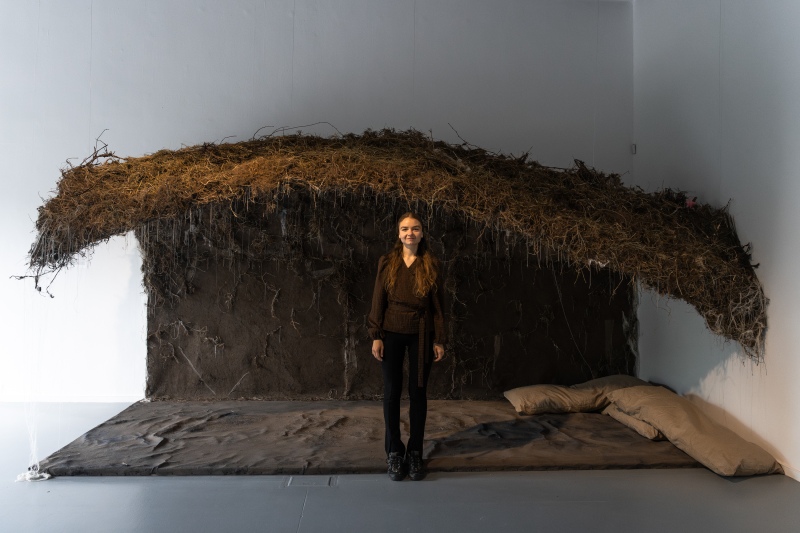
Ewelina Węgiel
Anna Pajęcka: Your artistic processes take a long time, sometimes extending to several years. I get the sense that this goes against the logic of art institutions, which tend to work through short-term projects that end with a product.
Ewelina Węgiel: I’ve worked like this for a long time. Even when I was studying at the Academy of Fine Arts, I was already entering into long-term relationships. From my second year, I collaborated with the community around the Arka Pana church, which stores rock from the moon. I’m not connected to the Church, but I’m interested in how communities function.
Later on, I spent a year and a half working with Polish preppers.
What does working over such a long period give you?
Access to things you don’t see at first glance. In the play Grunwald Rekonstrukcja [Grunwald Reconstruction], staged at the Współczesny Theatre in Szczecin, from the outside you might just see a “strange community obsessed with history.” But when you look more closely, their motivations turn out to be much more complex.
I agree that institutions are not really ready for this kind of work. I find it difficult to show films in galleries; exhibitions can be the wrong format as they often lack context and I work with sensitive topics and people’s real lives. Institutions tend to treat film as an “object in space.” That’s why I think so much about models of engagement and production. I usually finance these projects through municipal or ministerial grants. For me, the research itself – building relationships, meeting people – is a crucial part of the artwork. The audience also includes the people who are talking about their own reality and their own community, and I can offer them activities that are tailored specifically to them, in line with their understanding and intuition. There are still very few institutional pathways for this kind of work, especially when it comes to film.
How long did your longest process take?
The process at the Arka Pana church lasted four years and ended with my diploma. It was extremely intense – I was able to spend up to eleven hours a day there. I defended my diploma in 2021. I worked with preppers for about a year and a half, with the most intense period lasting around a year. At the moment, I also have a series of meetings that have been going on for about a year. Projects usually overlap, partly because of how we work – no one wants to meet every day – and partly because of funding structures.
You use the word “community” a lot. Is that at the core of your practice?
Yes, it’s a key issue for me. I’m interested in how communities in Central and Eastern Europe were formed, what kinds of stories were told about them and how many of those stories are being made up today – for example, narratives about pre-Christian communities. I’m not interested in telling stories about individuals. During my residency, I was invited to “get involved” in what was happening around Ujazdowski Castle, in the relationships between people and non-human actors. I’m thinking about older, shared stories in which non-human beings also played an important role. During the residency, I focused specifically on non-human communities.
The residency lasted three months. Was that a refreshing “window” compared to the length of your usual work, or more of a starting point for something you continued later?
I made a film during the residency. I knew as soon as I finished it that it was only a sketch. I went back to the escarpment many times afterwards, read more and researched the history of the place. Shortly after the residency, Marianna Dobkowska invited me to take part in the exhibition Soil and Friends. That gave me the opportunity to finish the film, which we showed at the exhibition in June. So the three months of the residency were really the beginning, and I continued developing the project afterwards.
What did you do at the Castle?
In the project proposal, I wrote about “tender observation” of the creatures living around the Castle. I was inspired by J. A. Baker’s book The Peregrine. Baker spent years observing a single bird, giving up cold, scientific distance in favour of simply being with it. His book also shows how misleading “illustrative” images of animals can be, and how much time it actually takes to really see them.
I wanted to practise mindfulness in this extraordinary space of the escarpment – one of the few places in Warsaw that has remained relatively untouched by humans. That helped me to better understand the history of the area and imagine what Warsaw as a whole might look like without human development. I was also looking for a connection to “deep time”: part of the escarpment is made of material brought there by a glacier around 20,000 years ago, which, on a local scale, isn’t that long ago at all.
I chose to observe the place at night. I was interested in the experience of uncertainty, of stepping outside my comfort zone. I’m very afraid of the city at night and of overgrown spaces, and at the same time I was reading about “hauntings” by non-human entities, including Sladja Blazan’s book Haunted Nature. During my residency, there were frequent violent storms – trees broke, branches blocked the paths. Being there at night allowed me to understand the place and the relationships on the slope in a different, much more physical way.
You also mentioned field research as a method.
Yes, it’s crucial for me. I learned this during my studies in Berlin: a minimum of four hours in one place, without writing, without recording anything – just sitting and observing. Only after that do I move somewhere quiet, like a café or a studio where I write everything down: what happened, what I felt. Four hours is the absolute minimum you need to get into the rhythm of a place and really embody your presence there. In practice, three months turned out to be ideal for me to properly immerse myself.
I have to try that. Why four hours, specifically?
Because that’s the threshold after which your way of experiencing things shifts. You stop analysing and start tuning into the rhythm of the space. It’s about entering into a relationship with a place through your body, not just your head.
You talk a lot about research and preparation before entering a community or a space. Looking at your projects, though, I also see a strong element of fiction. Does imagination have a place in your practice?
Absolutely. It’s essential to imagine different ways of being together in a damaged world. The “great” stories written by people – usually by the victors – are full of gaps and projections. Artists have always used fiction when dealing with history. Jan Matejko painted people from different periods in his battle scenes, and Jan Długosz described the Battle of Grunwald in an almost fairy-tale way. If their work still shapes our imagination so powerfully today, then I want to do that too. I find the strongest intuitions about ancient forms of communal life in old, fictional stories. I’m interested in continuing this kind of “history told through fiction”: collecting unsystematised knowledge and intuitions that emerge during long periods of observation.
In your biography, you describe your work as “quasi-documentary”. What does that prefix mean to you?
It means I use the language of documentary, but I bend it. A film is often legible to everyone as a “documentary”, which is a convenient starting point for both me and the people I work with. Then the boundaries start to blur. Communities suggest activities they don’t normally do, they propose scenes that “go into the film”, even though they wouldn’t count as pure documentary. This overlap between documentary and fiction allows us to look for truth not only in facts, but also in folk tales and in the stories people pass on. In the end, it gives viewers a more engaging experience, and the knowledge I’ve gathered really starts to “work” within the project. That almost always means bending the documentary format – at pretty much every stage.
Why did you choose film as your medium? I’m asking because your practice – collecting experiences, embodying, building relationships – feels very alive. Does film really manage to carry all of that?
I’m a huge fan of video, from experimental to artistic, and I actively fight for better working conditions for women video artists in Poland. Film has given me a lot. Artists’ films have opened me up to other ways of talking about land, origins, entanglements and conflicts. They work differently from journalistic or academic texts, bringing in other layers and modes of thinking.
Film is also incredibly useful in fieldwork. Everyone understands what film is, many people are excited to take part and want to see themselves on screen. And experimental film doesn’t need a classic three-act structure, which gives a lot of flexibility and makes it easier for people to get involved. In addition, film works brilliantly with time. I pay a great deal of attention to sound – it carries the most ghosts, the most intuition. Editing allows you to arrange the material intuitively and re-think the time of the process, as well as the collected, embodied experiences.
You often return to the past in our conversation. What does “after the end of the world” mean to you? I assume you don’t mean the Apocalypse of St John.
I think about it mainly through authors like Timothy Morton. Focusing on a coming apocalypse can be paralysing – many people, myself included, experience a sense of crisis and powerlessness because of it. It helped me to realise that the “end of the world” has already happened many times, on different scales and in different places. So now the task is to build something new, to follow different paths. As individuals, we can’t “save the world”, but we can create small, community-based actions. Thinking from this “after” perspective is actually motivating for me.
At the same time, I feel a deep sadness about how much of the history of the people who once lived here has been lost or destroyed, for example through Christianisation. We don’t know what their beliefs and stories were. Maybe fragments of them survive in fairy tales and fiction. I’m interested in alternative relationships with non-human beings; they contain many traces of animistic ways of thinking, where trees or other non-human entities have agency. That could be an important source of inspiration for building new kinds of communities.