GALAS
Anna Pajęcka: Who did you host in the Shared Kitchen as part of the Common Field project?
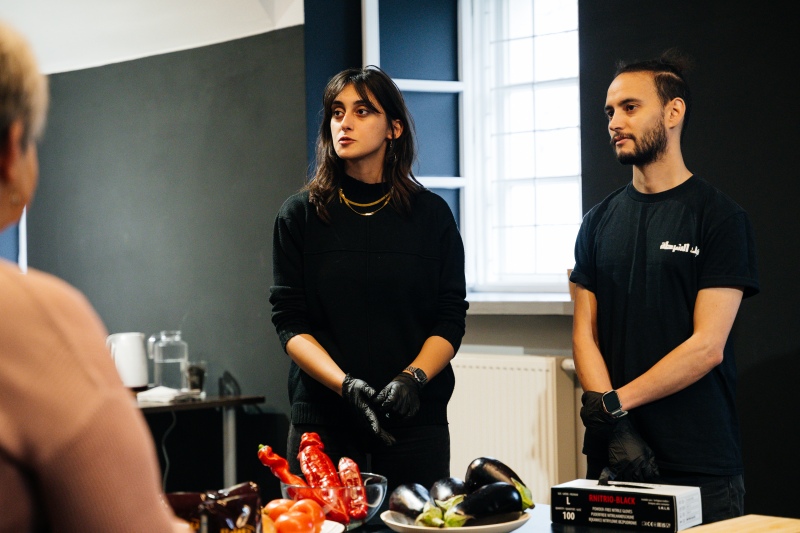
Vladyslav Gryn: We organised five meetings during the residency – five shared cooking sessions. We invited people with experience of forced migration and refugee status: participants from Chechnya, Ukraine, Belarus, Palestine and Afghanistan. Each of them has their own migration story and has been living in Poland for some time. That was a key criterion for us when choosing the workshop facilitators.
The format stayed the same each time. We asked everyone to prepare a dish they most closely associated with home – something with a special, personal story behind it, which could be shared through cooking. At the end, we organised a collective feast. All the dishes prepared during the residency were laid out on one table. It was both a celebration and a way of bringing the whole cycle together.
Taras Gembik: It was also important to us that the workshop facilitators could meet each other. There’s often an assumption that people with migrant or refugee experience form one homogeneous group, as if “everyone knows everyone”. That’s simply not true. So we created a space where, on the one hand, people from the Polish majority society could meet us and listen to our stories, and on the other hand, where the facilitators themselves could get to know one another. And, as we all know, food is one of the best ways of building relationships – it’s a fundamental part of being together.
It also mattered that the residency happened shortly after the political change in Poland. At first, we didn’t fully register it, but when we arrived at Ujazdowski Castle – I hadn’t been there for four years – we felt the symbolic weight of the moment very strongly. Working at that particular time, and with people with migration experience, was extremely powerful for us.
GALAS was formed in May 2022, after Russia’s full-scale invasion of Ukraine. Our first community activities took place in Ujazdowski Park, in the Enchanted Garden and in other locations. In a way, our stories came full circle – it felt like a return to the places where we had started. And, of course, there was also wonderful food, prepared by the facilitators together with us.
Do you remember what the dishes were?
Vladyslav Gryn: Because we asked for dishes “from home”, they weren’t always national dishes. For example, Chedzis from Chechnya prepared khachapuri – a Georgian dish, but also very popular in Chechnya and something she often cooks at home. A participant from Belarus made kvass and balabushki, sweet and delicious buns. Liubov from Ukraine prepared manzari. Amsalz from Afghanistan made buranibanjan, an Afghan appetiser. And from Palestine, there was makluba – a dish where rice is cooked with vegetables and then turned upside down onto a plate.
Talking to another resident – Julia Ciunowicz – I heard that working together, in her case with fibre, helps ease the awkwardness of conversation and makes it easier to open up. Does something similar happen in the kitchen, when you cook together? After all, you often hear difficult stories.
Vladyslav Gryn: I completely agree. It’s shared cooking, not a shared dinner. It’s not really about the food, but about the process – we meet in order to cook together. When people who don’t know each other, often newly arrived in Poland and with very difficult experiences, sit down at the same table, working together immediately “warms up” the conversation. Working side by side gives people a kind of excuse – the awkwardness disappears. At the same time, there’s a sense that we’re creating something together, even if only for the duration of the cooking. That makes it much easier to build a relationship.
Taras Gembik: And that’s exactly what’s so badly missing today: a focus on process rather than results. We live in a world of hypercapitalism, where cultural institutions – and we know this from our own experience – often operate according to the logic of “outcomes”. We create a space where no one demands anything. The only “result” is that we eat well. This doesn’t require special skills or exceptional focus. It’s a natural experience we’ve been learning since childhood: meeting, doing something together and then sharing food.
In that sense, our activities are also a form of resistance to the situation we all find ourselves in. The stories people share can be difficult, but it’s precisely because of this format that we’re able to really hear them. I’m currently working on a project with prisoners, and our main reference point is bell hooks’ idea that every story matters and that the most important ones may be those we usually overlook, especially the stories of marginalised and excluded groups. If we don’t listen to them, we lose a lot. Our shared history remains incomplete.
Listening to these stories – often marked by violence, displacement, a lack of a carefree childhood and uprooting – also becomes a strong political gesture. It’s a form of resistance to the realities these people come from, and that all of us, in different ways, are part of.
I’d like to ask about the process – I’ll use a word that may not be the nicest – of “acquiring” stories. In your work, you’re custodians of other people’s stories: you collect them and carry them with you. What strategies do you use to make people trust you and want to share their stories?
Taras Gembik: First and foremost, it’s about relationships and time. Even though we use the word “project”, we try to act against the logic of project-based work. We stay in touch, we invite people back, we meet repeatedly, we continue working together. That’s how trust is built. Without it, nothing moves forward. We also work closely with non-governmental organisations, like the Kolektyw Kobiety Wędrowne [Wandering Women Collective], Kuchnia Konfliktu [Conflict Kitchen], and the Bądź [Be] Foundation, which partner with us on activities related to cooking and community-building. I recently heard a line in a TV series: “No man is an island.” That’s exactly it. Our “repository” of stories exists thanks to the work of many people and a whole network of relationships. It’s never a solitary effort.
There’s also a huge amount of organisational work involved, and here I really want to thank Vlad, who’s recently taken on a lot of responsibility – communication, coordination and logistics. We also have our own migration experience. We came to Poland twelve years ago and faced many difficult situations ourselves. After Russia’s full-scale invasion, the image of Ukrainians in Poland changed dramatically – and in recent years it’s been shifting again. We speak Ukrainian in public, but we’re very aware of what’s happening, and what could yet happen. I’m not afraid to talk about the rise of neo-fascism – we’re witnessing it.
That’s why our actions, and the work of many others, are so important – not just symbolically. They’re real tools of resistance in a world that’s changing rapidly, politically, socially and culturally.
At the start of our conversation, it turned out that the workshops were led by women. As we were talking, I kept thinking about something Agnieszka Pajączkowska once wrote – that the kitchen and conversations around the table are an experience shared by many women, a space where the younger listen to the older. You’re a collective of men, doing work that’s traditionally “feminised”, and in this case you invited women with refugee experience to take part. Is migration itself also somehow “feminised”? Do women more often build communities and take on the burden of storytelling?
Taras Gembik: To be honest, we never thought about it in terms of “reversing” roles. We didn’t set any criteria other than the experience of migration and refuge. We also invited men – for example, guys from our Palestinian “family” who cook. Men and non-binary people have also been a part of GALAS’s story.
We don’t refer to cis-heteronormativity and we’re not creating a “male kitchen”. Our kitchen might appear feminised simply because we work with female friends, colleagues and sisters. And if you add the two of us, we also cook – the proportions shift straight away.
That said, we do see differences in how women and men experience migration. I have the sense that women today are more determined, more willing to speak about what they’ve been through. Social roles are changing. We’re slowly moving away from male hegemony, which has shaped narratives for centuries. Maybe it’s time for women to speak about their emotions and experiences – and we’re proud that they’re doing that with us.
Vladyslav Gryn: We didn’t think about the kitchen through the lens of “femininity”. This space is linked to reproductive labour – historically invisible, but very real and fundamental. In that sense, our project can definitely be read as feminist.
More broadly, what we do grew out of intuition and the moment, rather than from a carefully designed plan. We’re migrants ourselves, so we asked a very simple question: what did we miss when we first arrived in Poland? That’s how Shared Kitchen came into being. It happened spontaneously, when my mother was in Warsaw as a refugee. We cooked something for a GALAS event, saw how it worked and then started building further steps on that basis.
I’d like to ask about the word “hospitality”. In discussions around migration, it comes up all the time, but I struggle with it because it suggests temporariness – a guest who comes and then leaves. Your practices could be described as practising hospitality, but how do you feel about the term itself, which so strongly structures how we think?
Vladyslav Gryn: Yes, “hospitality” does imply a “guest” – someone who’s only here for a while. But what if someone builds a home here and wants to treat this place as their own? In our projects, we try to change the narrative around refugees and migrants. Very often, they’re cast as people who need to adapt, who need help and compassion. I don’t deny that support is sometimes necessary, but this framing creates a one-sided picture of integration. Integration is not just one-way – it’s a mutual process. The host society also has work to do. That’s why we put the invited participants in leading roles. They teach us, co-create the space and the community. From that perspective, they stop being “guests” and become neighbours.
The word “co-create” feels crucial here – it implies partnership. We do something together, rather than “giving” something to someone. Taras, you said before that you don’t really like the concept of “hospitality”.
Taras Gembik: I feel that the stage of “hospitality” is over. It made sense four or five years ago, when the first large waves of people on the move arrived. Back then, “hospitality” replaced “welcoming”. But the problem is that it focuses mainly on empathy and goodwill, while pushing aside the political and legal aspects of migration and refugee status.
Refugee status is grounded in very specific obligations: protection, access to education and support. “Hospitality” is soft and temporary – it can easily be shaped by media narratives and propaganda. And we can see how quickly it has swung from one extreme to another: from declarative openness to discrimination and racism. That’s why it’s worth talking not only about hospitality, but also about civic attitudes and responsibilities towards migrants.
Finally, I’d like to ask about one word from the description of your collective: solidarity, charity, integration – and fun. This idea of “fun” lightens the weight of the subject and I have a feeling it’s a really important part of what you do.
Taras Gembik: For me, it’s absolutely crucial. Without it, we wouldn’t have got this far. It holds everything we’ve been talking about, but adds joy, laughter and the ability to turn difficult things upside down. GALAS actually started with “fun”. In the second or third month after the full-scale invasion, we were all exhausted and in a very dark place. I said: let’s throw a party, let’s dance, let’s raise money – but in a way that allows us a moment to breathe and just be together. And it worked. Without that element, I wouldn’t have been able to keep going myself.
Vladyslav Gryn: I’d add that we always remember what we’re doing this for. We raise funds, we support local migrant and refugee communities, but we do it in a way that gives people a bit of healthy escapism. A reminder, even if only for a moment, of what “normal” life used to feel like – without constantly thinking about war and catastrophe.
These are hard times globally, when following the news can feel almost masochistic. That’s why we need to take care of each other – “fun” is one of the tools we use to do that.