Gosia Kępa
Anna Pajęcka: I like to start every conversation with a shared point of reference – for you, the word “field.” How would you define your field of practice? In your case, it also has a very literal meaning.
Gosia Kępa: My field is a space of relationships – with people, nature, the environment and myself. From the very beginning of my practice, I’ve been interested in relationality. I treated the residency as a field of encounter, both real and symbolic. I lived in the countryside for a while, so “field” also has a very specific meaning for me. It’s a space of coexistence and interdependence, a reminder that we don’t function in a vacuum, but within a network of connections that includes us and our surroundings.
Has the place you come from shaped your artistic practice in any way?
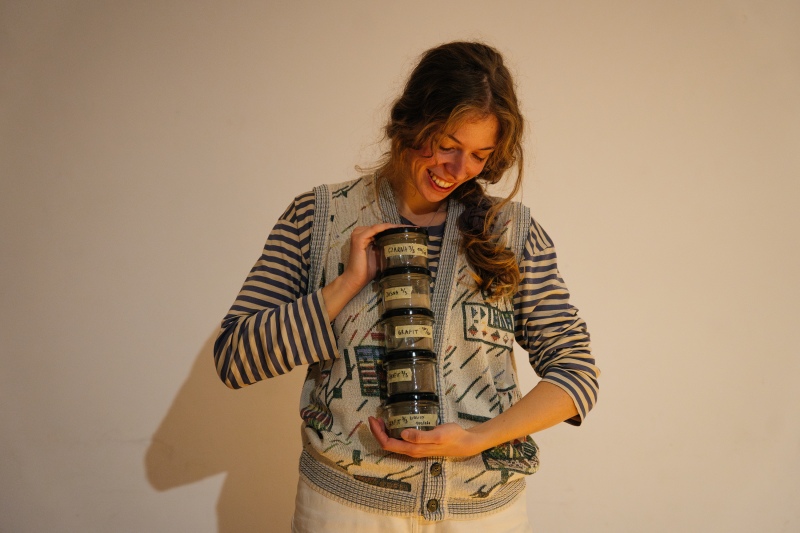
Today, I can say it has. I wasn’t really aware of it before, but that’s exactly what the project I started during my residency is about. In Common Field, I quite literally dug into the ground – I approached fields and soil in a very literal way. For three months, I walked around Warsaw collecting samples of urban soil. Autumn was ideal – flower beds were being turned over, so the soil was exposed. In the city, soil usually goes unnoticed: it’s contaminated, barren or hidden under paving stones. I collected, described and catalogued the samples, creating a kind of typology of Warsaw soils. Based on this, I developed a soil workshop where I examined what I called the “pigment potential of soil materials” – basically, the colours of the earth.
I don’t have any geological training, so the work was intuitive, though I did consult a geologist. It became more than just a project – it was an experience of deep contact with matter, a way of confronting the symbolic dimension of the land I come from.
So where are you from?
I’m from Świdnica in Lower Silesia, where my grandparents settled after the war, when the land returned to Poland from Germany. Their migration wasn’t dramatic – they chose to go there; they weren’t displaced.
Questions about our relationship to where we come from, and about roots that are severed, either by choice or by necessity, are very close to me. I never met my grandmother – Bronisława – she died before I was born, though people say we look alike. My middle name is Bronisława, in honour of her.
You mentioned consulting researchers on your project. Where do you draw the line between research and artistic practice?
I don’t think there’s a single answer, and I don’t think any position is necessarily wrong.
I’ve long been fascinated by the moment when science meets art, when scientific thinking turns into a form of artistic sensitivity. When we stop seeing hard boundaries – between art, the humanities and so-called “real” science – something extraordinary starts to happen. These are moments of contact, coexistence and mutual permeation.
For me, that boundary simply isn’t there. Science and art work like a spiral: sometimes separate, sometimes running in parallel, until at a certain moment they meet.
The project I developed during my residency was one of those moments. On the one hand, I consulted Dr Mariola Wrochna, researcher and academic based in Poland, specialising in plant protection, horticulture, and the biology of weeds. Later, while working on Shadow of the Earth, I collaborated with Professor Mariusz Lamentowicz, who researches wetlands and soil in relation to topography. These were extraordinary encounters. Scientists, like artists, can be completely immersed in their worlds. That meeting of scientific and artistic sensibilities really fascinates me – it’s an encounter driven by passion and curiosity, by people who could talk endlessly about what they love.
You sound incredibly excited when you talk about this. At the start of our conversation you mentioned “relationality.” That idea also applies to science, which is built on relationships – between phenomena, matter and structures. In your work, these worlds seem to intertwine quite naturally. Could you tell us more about Shadow of the Earth?
The title came out of a conversation with Gosia Kuciewicz from Kolektyw Centrala, whom I met during the Vistula residency of the Flow collective, founded by Agnieszka Brzeżańska and Ewa Ciepielewska, as part of the Liquid Becomings project.
We were travelling along the Vistula on a barge with an extraordinary group of artists. It was an intense, beautiful, but also difficult week – the river was at a record low, and we felt that very clearly.
During the trip, Gosia told me about a phenomenon I hadn’t known before: the Earth’s shadow. It’s an atmospheric effect you can see at sunrise or sunset. When you look towards the sun, a delicate grey band appears in the sky behind you – a shadow cast by the planet itself onto the layers of the atmosphere.
I took that moment of stopping and looking in the opposite direction as a symbol of relationships – with the Earth, with nature, with myself.
Language is also very important in my work. I’ve always been fascinated by wordplay and by the tension between form and content. So I started thinking about the Earth’s shadow symbolically as well: as an encounter with the past, with what’s hidden, elusive, sometimes difficult.
The word “shadow” also carries psychological meanings – it touches on roots, memory and the search for one’s place in the world and the time we live in.
You speak about your relationship with earth and about relationality, which keeps returning in your work. What you describe sounds less like a relationship with another person and more like a relationship with matter – something very individual, even solitary. Do your artistic relationships mainly concern matter, or do they also include other beings?
It’s true – the relationship I was describing is largely a relationship with matter: with materials, techniques and elements. That’s not accidental. I’m controlling by nature; in my everyday life I need to have an influence over many things. In my artistic work, though, I often choose methods that are beyond my control. The process starts to take on a life of its own, and I have to learn to let go and trust what’s happening. That’s an important practice for me – learning to give up control and allow things to unfold on their own terms.
At the same time, relationships with others matter to me a great deal. And I’m glad you used the word “beings”, because my idea of relationality also includes non-human beings. That’s a crucial part of my work, especially in projects connected to water. In Call Me River, I speak to rivers, symbolically giving them a voice and entering into dialogue with them. Something similar happens in my soil projects, where contact with the earth and its microorganisms becomes an encounter with non-human forms of life.
Alongside this, there’s also my return to photography – my own personal renaissance. Photography has always been my tool for encountering other people.
When I think about artists like you, working through a process and creating ephemeral situations, it feels as if photography often becomes the only medium that allows a relationship to form between the activity and the audience. When viewers encounter process-based work, what they receive is often a desire or fantasy – the urge to enter a similar situation, to repeat the gesture.
That leads me to the question of involving other people in your practice. Do you invite people to participate? Do you give them tools that let them approach what you do? During your residency, you also ran a workshop.
This is still quite new for me. Being able to lead a soil workshop during the residency was like a spark – it made me realise how important this aspect of my work actually is. I knew I had a certain lightness in “holding” space, even in workshop situations. I enjoy it, and I’ve had similar experiences before, but I never treated them as central to my practice. Common Field brought this back to me and gave me permission to return to it.
After the residency, I ran another workshop, again focused on soil and soil pigments, and another one took place as part of the accompanying programme for the exhibition Soil and Friends. Each of these meetings has been incredibly valuable to me.
What do you “teach” people in these workshops?
I don’t “teach” anyone anything [laughter]. I don’t want to put myself in the position of an expert. What I do instead is create a space for an encounter – with oneself and with others. It’s a space for process, not for producing an outcome. Again, it’s about redefining the goal.
We grew up in a system obsessed with results, products and assessment – from school art classes all the way to art academies. And very often that’s simply absurd. I invite people to rethink what creative activity actually means.
The first workshop I ran with Natalia Krata was about connecting everything that exists. We looked at mycelium as a metaphor for the network that holds the world together. In the outdoor workshop, we worked with compost – understood both literally and symbolically, as a process of decomposition and nourishment. Each time, the point was the same: to shift attention away from the “product” and towards the relationship with the material, mindfulness, and accepting chance. It’s a practice of letting go of control – which is probably why it resonates with me so strongly.
During the After Summer workshop, I invited participants to think about what remains after summer, both literally and metaphorically. The very title of the open-air workshop served as inspiration: after a period of intensity and movement comes a pause. It’s harvest time, when apples ripen and crops are ready. Some things we consume straight away, some we process, some we store for later. It’s a beautiful metaphor for deciding what to keep and what to let go of.
In the workshop, I translated this into the idea of compost – something that comes to an end in order to become the beginning of something new.
Soil entered my life last autumn – and it revolutionised my life.
“Soil revolutionised my life” – I think that will be the title of this conversation.
I’m really not exaggerating when I talk about a revolution. Something significant happened in my life recently, something that set a whole series of processes, insights and transformations in motion. And that was the moment when I felt I was in compost. And that I am compost.
You know how I mentioned de-concreting soil in the city earlier – when you lift a paving stone and underneath there’s soil that hasn’t seen light, air or water for years. It’s compacted, dry and lifeless. If you pour water on it straight away, even with the best intentions of “feeding” it, it will simply rot, because it has no space to absorb anything. It needs time. It needs to breathe.
That’s why you first cover it with compost, dig it over and leave it alone to regenerate. Soil has its own wisdom and its own rhythm that can’t be controlled. Compost is also an encounter with the shadow – with that which has reached the end of its cycle. Compost is death and rebirth. Something has to die for something new to appear. Just like in a forest: a tree falls, and new life starts growing from its trunk. An entire forest can grow from the death of a great tree. I’m exhausted after the last few weeks, but at the same time I feel an incredible clarity. I feel that this is the clearest moment of my twenty-eight years of life.
Earlier, you worked mainly with water – flowing rivers. Soil seems like the opposite of that. How did you move from water to soil?
Maybe I simply “came out of the water onto land,” like in evolution. It was a natural stage – symbolic and organic at the same time. In my work, I often do things before I fully understand why.
In Old River Bed, I placed a cotton fabric on the surface of an old river bed of the Oder and left it there for four weeks. When I took it out, it carried traces of the river’s life – a natural negative, almost like a photograph.
What looked dead turned out to be full of life. With Common Field, I wanted to repeat that gesture with earth. But soil fascinated me so much that it became a subject in its own right – a return to childlike wonder.
To the point where you can get dirty without any negative consequences.
Exactly. That return to childlike curiosity is, for me, the essence of creativity. When everything fascinates you, when you experience things as if for the first time. That’s why I always encourage people in my workshops to “get dirty”. Touch the earth. Feel its structure, smell it, notice its texture and even its sound. Because earth makes a sound. You really can hear it.
If someone reading this wanted to try that kind of contact with soil themselves, where should they start?
The answer is very simple: just go outside and stoop down. I know it sounds trivial, but that’s what simplicity is. It’s about being there – stooping down, touching the earth, sitting with it, grounding yourself. It’s about meeting the earth. And meeting yourself.