Julia Ciunowicz
Anna Pajęcka: Which plant do you most enjoy working with?
Julia Ciunowicz: Right now – nettles! I’ve got a bit of a personal fixation on them. But I’m also very fond of bulrush and ribwort plantain. I’m fascinated by their resilience and by how closely they’ve been connected to humans, both historically and today. For now, those are my favourites.
How would you describe your artistic practice and how did you arrive at it?
It grew out of research and activism. I was initially interested in environmentally engaged art in Poland, and at the same time I was involved in activism at school and at university. I was looking for a space where ethics wouldn’t lose out to production and the market. For a while, I turned towards functional design – I ran a small brand making plant-dyed clothing. After two years, I realised that this kind of “usefulness” didn’t resolve my dilemmas. I came back to art and I feel much better here. I can work towards change without feeding overproduction, while still genuinely engaging with fabric.
Does your work make you see the world through its structures?
Very much so. My practice is rooted in learning to look differently at everyday reality. It’s shaped by years of research and thinking about invisible relationships between plants, about fibrous structures, and about historical threads. I often find that I can’t walk through a new place without unconsciously mapping it: I look for plants, for connections, I ask where they came from. Underground, I immediately “see” networks. It’s become a reflex – focusing on the relational and structural aspects of plants, both within themselves and between species.
How does your textile practice – with its focus on fabric, structure and relationships – shape how you function in non-art spaces?
For me, it feels natural, because an artistic perspective was not my starting point. I came from theory and social activism. At first, I thought about the principles I wanted to follow in art – ethical ones, beyond the logic of production and the market. Only later did the question arise of how to translate them into practice.
The starting point is always fibre and what it does to me, and to relationships – with nature and between people. Art gives me a space for abstraction and sensitivity, where natural and structural processes and theories can enter the realm of coexistence, reflection and bodily experience. It’s chemical and biological at the same time as it is relational and emotional.
In the context of fast fashion, textiles are often described as one of the most problematic forms of waste – overproduction, long lifespan. In your work, that logic seems reversed: durability isn’t the priority.
Durability isn’t an end in itself for me. I want my works to be made from biodegradable or recycled materials, and to be able to decompose and return to compost once they’ve done their job. It’s important to me that what I make doesn’t become a climate burden. That doesn’t mean the works are fragile – they can be durable in use, just not monumental, not built for eternity. I don’t need that kind of eternity.
…And then the conservators appear. Hasior said, “Let things return to the earth.” The conservators reply, “The artist’s will is not the most important thing,” and preserve the works as documentation of a practice. How do you see this?
I understand both positions. Conservation follows the logic of preserving evidence and keeping works in institutional circulation. My logic is different: a work can have an inherent right to disappear. If an institution decides to preserve it, it’s important that it accepts the work’s life cycle and uses documentation instead – a description, samples, composting instructions, or a kind of “map” of materials. Not everything needs to survive as matter; sometimes the medium is knowledge of the relationship and the process. It’s good when a museum can handle this not going against the work, but in line with its internal logic. At the same time, there’s a very real issue with perishable materials: they have to be cared for in ways that don’t endanger other objects, and their specific life cycles need to be acknowledged.
Is this a time for “green conservation”?
I hope a “green trend” in conservation will emerge – people with a different sensitivity to matter, open to works that are process-based, decomposable and repairable. That would require a shift in thinking on both sides, from artists as well as institutions.
What did your residency as part of Common Field give you?
Focus and rhythm. I was able to work calmly on a project about fibrous plants in the urban environment. I mapped the greenery around the Castle, thinking about fibres from household “waste” plants and wild species, as well as from garden plants that have spread and can become invasive. I wanted to avoid idealising the countryside – to bring rural fibre practices into the city without fetishising peasantry, while remaining attentive to the contemporary context of fast fashion. It was about experiencing time and labour – how long it actually takes to extract fibre before even the smallest piece of fabric can exist – and about developing a communal view of plant relations in the city.
You organised “textile walks”, which I found really interesting.
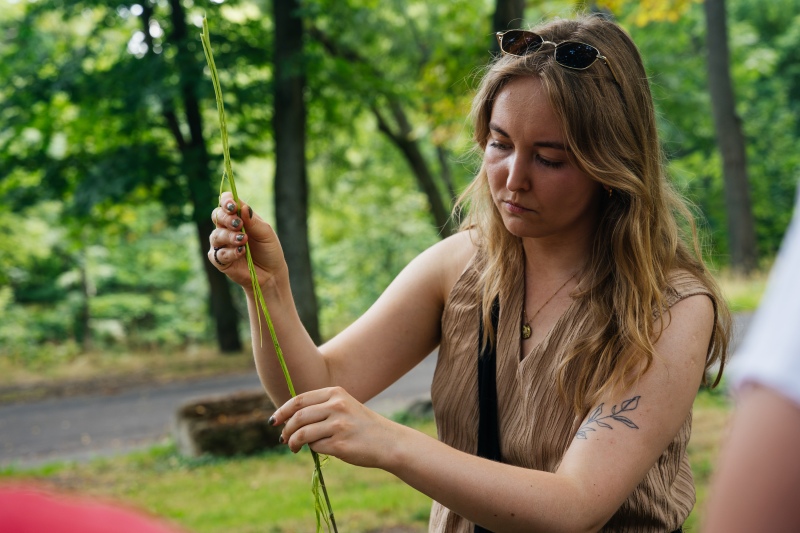
I wanted to move away from the workshop logic of “I’ll leave with a product in my hand.” Instead of offering a weaving course, I wanted to offer a process. We walked around the area collecting nettles and horseradish, because it turned out there were huge, rarely mown patches under the escarpment near the Castle. That became the starting point for many hours of fibre extraction. No rush, no fetishising the outcome – just attention to structure and relationships. There are perfectly flat stones arranged in a circle on the Castle grounds, which turned out to be an ideal workspace. Horseradish needs a hard, even surface: the fibres are literally “combed” out of the stems. Nettles, on the other hand, need to be rolled thoroughly on a flat surface to reveal their structure.
But nettles sting!
We wore gloves while harvesting. Afterwards, all you need to do is wipe the leaves and run your hand once along the stem, and you can work with bare hands. The hairs mostly sting on the leaves. Even so, I still get stung sometimes, and that matters to me. Nettles set boundaries. They have a kind of guardian quality – the sting limits excessive exploitation. At the same time, every part of the plant can be used, and historically it has often saved people. It has a brave, valiant “personality”, but after a brief preparation it’s easy to work with in textile production.
You talk about plants as subjects.
Yes. I’m interested in the relationship, not just in utilitarian use. That shift changes how you look, and how you work.
You mentioned bringing rural practices into the city without romanticising them. Historically, working with fabric was a social activity.
In my experience, manual work – simple, repetitive, hand-to-hand – is a great conversation starter. The awkwardness of meeting disappears; there’s no pressure to “produce an effect”. Pulling fibres, twisting cord – these actions can be done almost automatically, and at the same time you can see time passing, measured in metres or in bundles of fibres. It’s a relational catalyst, a bit like working together in the garden: it doesn’t burden you with ambition, it gives you a break, it organises your thoughts.
And it’s physical.
Very much so. Textiles are close to the body and the home, which opens up the field of art to people who usually say, “It’s not for me.” Family stories start to surface during these meetings – grandmother’s wall hangings, crocheting, domestic vocabulary. It sits somewhere between: familiar and institutional at the same time.
You once said that “plants are records of a place.” What do you mean by that?
That’s my working research thesis. Historically, local vegetation shaped local crafts. In wetlands, people used rushes, bulrush and reeds, which led to specific techniques and objects. Today, I see this in two ways. First, the geology and chemistry of the soil affect plant composition and therefore the properties of their fibres – the same species behaves differently in different places. Second, in polluted areas, plants become a temporary record of contamination. We don’t see arsenic or excess nitrogen directly, but we can read them in the plant. That’s what makes the work truly site-specific: the material carries the trace of the place.
I also go down to the level of everyday practices. I map habits, manual techniques and domestic uses. Plant knowledge was once fundamental; today, we need to recover that – also in cities, where ecosystems are dense and not immediately legible. That’s why I include invasive plants as well: they, too, write a contemporary record of a place.
Is your work seasonal?
Very much so. In summer and autumn I work with plants; in winter and early spring, with wool. I don’t store large amounts, so the “green” season is intense, and then I switch to wool.
Where did the focus on wool come from?
At the end of last year, a neighbour living next door to my grandmother’s house – where I spent my childhood – rescued two sheep. That’s how I started working with “neighbourhood” wool and looking into the history of northern breeds. Pomerania has its own sheep, but in Poland it’s still an undervalued resource, often treated as waste by breeders. In our imagination, sheep belong mainly in the mountains, yet today there are also large flocks in the north. I’m interested in the locality of fibre, and in how little care we give to native breeds and traditions compared to the merino fetish, which turns an extraordinary natural fibre into a mass industry.
And how about the continuation of your residency at Ujazdowski? What did it open up for you?
A great deal. The residency gave me the luxury of focusing on process. For several months, I walked around the city “in search of fibre”, meeting people and testing routes. On an everyday level that may seem abstract, but for research it is invaluable. Because of this, I developed urban textile practices and mapped places in central Warsaw where it’s genuinely possible to work with plants. The institution also supported further collaboration with the Green Team as part of a long-term, process-based relationship, which I value enormously.
So, is the nettle the plant you most associate with Ujazdowski?
Absolutely. It has to be the nettle.