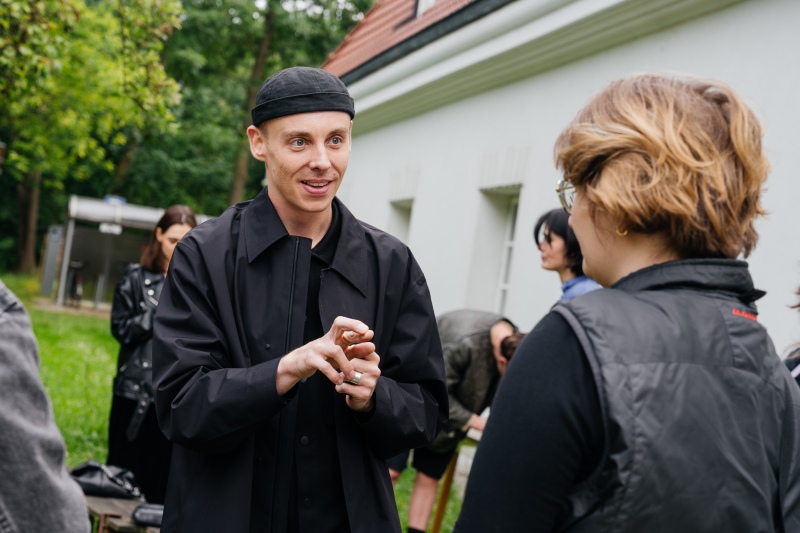
Konrad Fleszar
Anna Pajęcka: I’m interested in your combination of residencies at the Botanical Garden and Ujazdowski Castle. How did you end up there?
Konrad Fleszar: I applied for a residency at the Botanical Garden because my PhD combines design and biodiversity, and I needed real access to biological knowledge and scientists. The programme was run in partnership with Ujazdowski Castle, so it was clear from the start that the research part would happen in the Garden, and the curatorial and artistic part at the Castle. In the end, I spent a month and a half in the Garden, working on specific research problems, followed by three weeks at the Castle, benefiting from curatorial mentoring. The Garden gave me tools and access to specialists, while the Castle helped me focus on language.
I was also surprised by how similar the two institutions are. A botanical garden actually functions a lot like an art institution: there are conservators, curators of “exhibitions” and a kind of council that decides on exhibitions and exchanges. The director, Marcin Zych, suggested the idea of “evolutionary convergence” to me – whereby different organisms in similar environments develop similar mechanisms. You can see something similar here: the two institutions are different, but they operate in comparable ways. That said, at first the Garden was wary of an “artist” who might “put something up and cause damage.” I understand that fear – artistic PhDs in academia often have very little to do with hard science.
And how do you feel about the word “artist”? With your background and such a mixed practice, do you identify with it?
It’s a tricky word. I’ve only recently started calling myself an “artist”, even though art brings together very different fields that don’t always overlap neatly: visual art, design, conservation. When people asked what I did, I used to hesitate between architect and designer. But over time I started working with smaller formats – workshops, participatory activities, micro-projects – that clearly sit within the artistic practice. I feel at home there, and that’s when I was finally able to say: I’m an artist. It’s not about ambition, really, but about coming to terms with imposter syndrome. There are people around me who graduated from art academies and have dozens of exhibitions behind them, while I’ve done things like building a house in Masuria. Still, I found a space where all of this comes together. So today, I do identify as an artist, even though I find it slightly amusing that I’m only “officially” one now that I’m doing a PhD in art.
In a conversation with Gosia Kępa, another Common Field resident, we realised how many connections there are between science and art – relationships, structural thinking, and the fact that science itself can be very creative. With your experience in both fields, how do you see this relationship?
Science and art work in very similar ways. In both, you make decisions and look for solutions in order to create things that don’t yet exist. Even computer science can be deeply creative. Both fields are also about relationships – between data, people, organisms and institutions. The problem is often institutional. In research teams, an “artist” is sometimes seen as someone who’ll “build something, and then take it away.” But that’s changing. There’s a growing need to translate research into something more human and accessible. Sometimes art does exactly that – like at MIT, where artists are invited to interpret scientific research through artistic language.
In my own practice, art has to have a purpose and be created in collaboration with scientists, technologists and institutions. The boundaries between painting, sculpture, installation and performance overlap anyway. Any intervention in space affects not just people, but also microhabitats – it changes flows, shadows and microclimates.
At the moment, in a project linked to Ujazdowski Castle, I’m working on a ceramic object somewhere between a sculpture and an installation. The 3D printing required knowledge of physics and materials science, while the location demanded biological knowledge about interspecies networks and about how the object would affect its surroundings.
So tell us – what exactly did you do during your residency?
It started with a dendrological analysis: looking at the life cycle of trees in the city and how we interfere with it. Trees grow leaves and shed them in autumn – that’s a process with a clear ecological function. But in cities we clean everything up, because we want things to look tidy and “nice”. I was interested in what we lose through this approach: resources, habitats, micro-circulation. More importantly, I explored what kind of project could actually respond to that loss. I didn’t just want to analyse the problem, but to see how design actively shapes these processes. So I focused on how plants perceive – on their “senses”, in a way. The core of my work became very specific: I scanned the surface structures of tree trunks from different species to understand which ones are most easily colonised by other organisms – from mosses and lichens, through spiders, to climbing plants. I was looking at where these structures appear and which of them are “best” from a biodiversity point of view. Based on the scans, I carried out analyses and started transforming them into forms that could be introduced into the city as microhabitat “generators”.
Microhabitats, meaning…?
Small-scale structures not for people, but for other organisms. Often invisible, but absolutely necessary.
There’s also a very practical context here. In many countries, especially in Scandinavia, part of any construction budget has to be spent on art. Sculptures end up in courtyards, often because there’s a car park underneath and planting trees is impossible. And I thought: what if the “space for a sculpture” was used differently?
That brought me back to the question of what art actually is – and what I do. I decided I wanted to “sell something that looks like art, but isn’t art as I understand it.” As an artist, I can put things into a contract – for example, that an object doesn’t require maintenance. By placing this kind of “sculpture” in space, I meet the human need for contact with art, while at the same time creating a form that genuinely increases biodiversity: it holds water, gives climbing plants something to latch onto, creates micro-shelters for insects, and surfaces for mosses and lichens. Aesthetics and contemplation are still there, but the ecological function comes first. Under the label of an “art installation”, I’m proposing a kind of micro-development. The client doesn’t need to understand the full ecology of the object – what matters is that it actually works for biodiversity. That’s my main project, which took shape entirely during the residency and which I’m now putting into practice.
You mentioned that you spent three weeks consulting at the Castle. What came out of that?
In the Garden – alongside working through specific cases with curators and researchers – I did a lot of talking with people about how they actually work. My initial thesis for my PhD was about empathising with plants. I assumed that people who work with plants every day naturally treat them as subjects. I got a reality check on just the second day. While walking through the greenhouse, a curator pulled out a banana plant, threw it aside and said, “This isn’t your place,” and moved on. Like a doctor in an emergency ward, he makes fast, unsentimental decisions because the system has to function. That’s when I realised that practice can matter more than declared sensitivity.
At Ujazdowski Castle, I wanted to see whether similar “hard” decisions exist on the art side. I met with curators and asked very basic questions: how they ended up at Ujazdowski, how long they’d been there, how they understand art, when it’s worth letting go of an object, and when you should trust the artist and follow the process. I arrived at a fortuitous moment – the exhibition Soil and Friends was opening. Julia Harasimowicz and I talked about projects at the intersection of ecology and art. With Marianna Dobkowska, the curator of the exhibition, we discussed where an “ecological” project stops being ecological – where there’s real meaning, and where it becomes simply a gesture.
I also felt that Ujazdowski really “translated” the tensions between my different fields. There was an understanding of the project’s critical language. That mattered a lot to me, because in architecture I used to be called “Mr Artist”, while in the art world I’d hear that my work was “too engineering-driven”. Here, for the first time, those identities actually started to come together.
Since you work with non-human actors and non-anthropocentric thinking, I’d like to ask how you see the museum or art institution from an ecological perspective. What could it do if it genuinely took non-humans into account?
I’d start with a very basic fact: every institution and every piece of architecture colonises space in some way. It takes space away from other forms of life, even though plants and animals have their own agency, which we usually ignore. Museums exist for people, but they can also work for non-humans – if they’re willing to change their practices. Instead of loudly declaring themselves “environmentally-friendly” from the outset, it often makes more sense to introduce objects that look like art – or simply are art. Given the endless appetite of human consumerism, we can smuggle in designs and objects that have a real, positive impact on the environment. For example, objects designed as microhabitats – ones that retain water, offer shelter for mosses and insects, and just quietly do their job, without jargon or greenwashing.
It’s also important to reverse the order of communication. First comes the exhibition experience, and only then the realisation that curatorial, design and material decisions have supported biodiversity. That lowers resistance while still achieving ecological goals. Added to this is a conscious reduction of control: accepting that you won’t manage everything perfectly, allowing some interventions to be colonised, and introducing infrastructure that doesn’t harm the environment – grey water systems, composting materials, limiting artificial light outdoors. It’s still a museum “for people”, but one that creates real space and rules for other, non-human actors.
Cities are designed for people, while other inhabitants tend to just “cling on” to them. But for some time now, we’ve seen simple – and I think wonderful – solutions emerging: nesting bricks for wild bees built into façades, bat boxes, meadows and patches of greenery left alone, not constantly “tidied up”. On an infrastructural scale, there are wildlife overpasses above motorways. In Kraków, several micro-forests have been created, with unmown grass and minimal intervention. Sometimes it’s enough to just turn off the lights in a park. Nocturnal animals can hunt again, and plants aren’t thrown out of their circadian rhythms. Disrupting natural processes, or subjugating space entirely to human needs and language, has very real consequences. The fact that these projects exist shows that change – and coexistence – is possible.
Around Ujazdowski Castle, which has been running a green programme for years, you could actually observe many of these practices in action.
What’s happening around Ujazdowski really does seem encouraging. You can clearly see that it’s possible. There’s no need to be afraid of things like not mowing, installing bee houses, or leaving space for other organisms to exist.
Could art institutions and museums become urban enclaves – fragments of the city dedicated to non-human actors?
In an ideal world, everyone would work like this. But let’s be honest: the city’s greenery department might organise brilliant lectures, but they will attract mostly people who are already convinced about the idea. An art institution works differently. You pass it on your way to get a coffee, you notice an object and you simply “want to have it.” And that’s where the designer’s role comes in: to propose a form that’s attractive enough to trigger that basic desire to own it, while the object’s hidden function is ecological. So it’s not for the owner’s ego, but for its “co-residents” – mosses, lichens, insects.
Of course, this opens up a whole set of difficult questions. When does production make sense, and when should it be limited? Is producing pro-ecological art actually ecological? For me, it makes sense when it teaches and transmits knowledge and practices in a subtle way. You want an object, but at the same time you introduce water retention, colonisable surfaces or places of refuge into the environment.