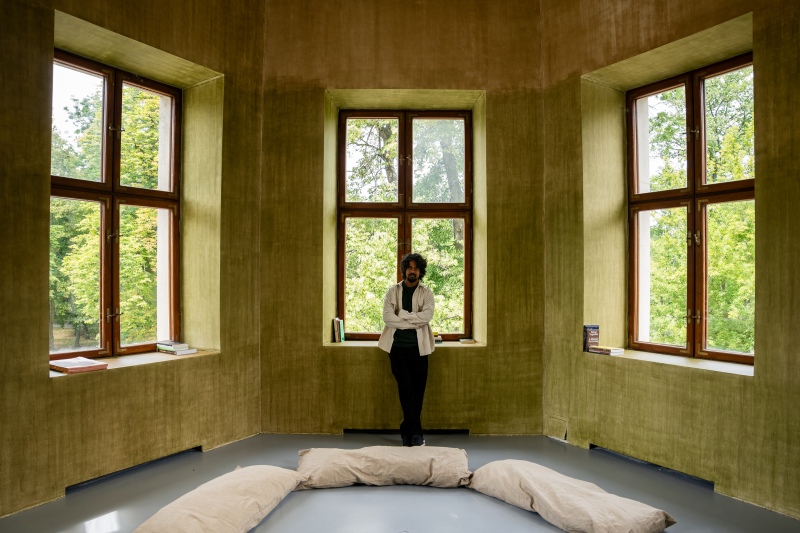
Maksud Ali Mondal
Anna Pajęcka: You work with many different media and often draw on scientific knowledge. What is your background, and where does the knowledge you use in your art come from?
Maksud Ali Mondal: I was born and raised in Bankura, West Bengal, in the eastern part of India. It is a region full of rivers and wetlands, not far from the Bay of Bengal. The landscape is shaped by agrarian practices, rituals and water bodies, and people’s lives are closely connected to the landscape and to the rivers. I grew up in this environment, surrounded by this wilderness and agricultural practices, and I learned a lot simply by observing and taking part in everyday practices. These rivers, less than a kilometre away, are incredibly rich in biodiversity, not always cultivated and often wild.
At the same time, listening, seeing and observing the violence that happened and is still happening today to the minorities and to the other castes and communities, where life is being forced, controlled and dominated due to name, language, religion, colour and identity. This is reflected in my works as a subject of unconsidered, unnoticed, neglected, abandoned or non-human interactions.
In 1950, Kethardanga (my village) was attacked by neighbouring villages with the help of the military. The violence was extreme, houses were burned, people were killed and many sought protection inside Munshir Dalan, the only concrete structure that survived. Women and children took their own lives by jumping into a well to escape the violence. When the attack ended, the survivors were sent to East Pakistan (now Bangladesh) as the government declared the area unsafe. Unable to survive there, they returned to their land, where discrimination and doubts over citizenship continue. This unrecorded history has remained a collective trauma, unspoken and overlooked in the mainstream. It was also my first political encounter as a child, seeing this remained architecture and listening to the story.
What about school?
At first, I thought I would study literature, because I loved both art and literature as a creative and free form of thinking. I enrolled in a programme in Bengali literature, my mother tongue. However, I quickly became uninspired and demotivated by the institutional curriculum and syllabus, and by the way it was taught as a subject. I felt that literature was very limited and treated just as a subject, rather than a creative practice, with thinking that was so narrow. I also failed to connect with the way the school was teaching.
This created a strong inner conflict. Around that time, I discovered a very inspiring school –Visva Bharati, in Santiniketan. It was founded by Rabindranath Tagore, a Bengali poet, novelist, playwright, music composer, painter, philosopher and social thinker. In one of his texts, I read about this universal university where the world makes a home in a single nest.
He imagined a place where learning is free, open and in harmony with nature, where culture and knowledge unite, where East and West mix through the exchange of knowledge.
and imagined as a centre of global humanism, creativity and freedom of thinking. This idea touched me deeply: an education that invites you to engage with your surroundings in many different ways, beyond religious boundaries. I thought: “This is the kind of school I should go to.” By then, I was already practising fine art on my own, later with two teachers (Manohar Nandi and Swapan Pal) in Bankura, and I began to feel that maybe I should study fine art instead of literature, though I had many other interests: science, indigenous knowledge systems, and making things with my hands. Fine art seemed to offer a space where all these interests could meet. I decided to join a fine art department and that decision completely changed my practice. Tagore’s philosophy, his books, essays and poems, as well as the environment of the school, completely transformed my perspective. The landscape of Santiniketan is also very diverse, quickly becoming a crucial part of my way of seeing. That is where my journey in fine art really began – where my background in ecology, my political awareness and my interest in various forms of knowledge came together.
After studying there for three years, I had the opportunity to come to the Royal Academy of Art, Netherlands, for one semester, as part of an exchange programme. That was another important step, opening up new perspectives, learning, thinking and working.
If you had to describe your art practice in very simple words, how would you do it? I’m asking because I sometimes have the impression that your work might seem difficult for a broader audience. Do you think it is hard for people to understand?
I don’t think so. Everyone observes and understands art from their own perspective, and that's the understanding. My work has many directions and many contexts. One piece can open up multiple layers and readings, but the tools and processes I use are very close to everyday life. Sometimes I literally make art in the kitchen, from the kitchen. I work with discarded materials or neglected objects, whether from agricultural waste or from everyday life. These materials are a apart of people’s daily experience.
A good example is Synthesized Forest, the work I’m developing now. A space painted with chlorophyll. I make pigments from plants and paint the room with it, making it a light-sensitive component. The way I extract chlorophyll is very similar to cooking: grinding leaves, straining them, fermenting and ending up with something that looks like spinach soup. This “kitchen practice” creates an immediate connection. People often think of making soup, herbal tea, or home remedies.
I use plants like nettles and dandelions, which exist in the place between valuable and valueless, important and neglected. They also have long histories and cultural significance. People make teas, medicines and recipes from them. Even if viewers don’t follow every conceptual layer, when I say, “This is made from dandelion,” many connect with their own experience with this plant: “I remember using this plant.” For me, that shared memory is already an important understanding and building the relationship.
In general, it is not always necessary or expected for viewers to receive a work exactly as the artist imagined it. People have different life experiences, imaginations, histories and forms of knowledge. They absorb art through those lenses. This is also a strong understanding and reality. That is true not only for my work, but for perceiving art in general.
Tell me something more specifically about Synthesized Forest. What is this work about, and what kind of research are you doing at Ujazdowski Castle?
Synthesized Forest is based on a photographic process called anthotype. I chose it because I’m interested in what is neglected and abandoned – things people ignore, avoid or throw away. I connect metaphorically as well as conceptually to such things and always ask: why are they rejected, when there is often something beautiful and meaningful in them? Chlorophyll, the green pigment in plants is used in anthotype to make images. Light creates the image, and over time, it fades because the material is light-sensitive. Historically, people didn’t like this fading process in photographs; the tendency is more towards a permanent image, so this method disappeared from mainstream use and was replaced by more stable chemical processes. I decided to reclaim anthotype, not to make the photographs, but to work with its light sensitivity and transformative processes – the way plants themselves respond to sunlight. I extract chlorophyll and use it to create an entire space.
In Synthesized Forest, the room is painted to resemble a plant cell seen under a microscope. Plant cells often appear as hexagonal units, like in scientific diagrams. When I first saw the room at Ujazdowski Castle, I felt that its architecture already echoed this structure. It was an ideal setting. When you enter the work, you are metaphorically entering a plant cell, a plant’s internal system. Usually, we see plants only from the outside. Here, you step inside a “plant space,” into the very substance that makes photosynthesis and life possible.
The piece also shifts the relation between humans and plant life. You become almost like an insect entering a plant cell. It plays with scale and perspective. We tend to place humans at the centre of everything, but the universe is vast; on a cosmic scale we are almost invisible. In this work, something microscopic becomes enormous. A cell becomes a room, and that creates a new sense of relationship with other organisms. Transformation is crucial.
There is another important aspect: every person who enters the room leaves a trace. Because your body blocks the light, your shadow is recorded on the chlorophyll surface. You don’t see it immediately, but if someone stood in the same place for a long time, their silhouette would eventually appear. The work contains a performative element that remains mostly invisible while still existing.
The aesthetic comes from this slow transformation. The space is alive in a way – changing over time, responding to light – so the architecture starts to feel like a living organism. I am fascinated by this idea: that a building can behave like a plant; that a human can step into a plant cell. It challenges the way we think about our own position and about architecture, which is usually treated as a dead, neutral container rather than an active, responsive environment.
This feels like the right moment to ask more broadly about exhibition spaces. How do you work with museums today? I’m especially interested in your site-specific works and those that transform over time. How does the traditional white cube relate to your practice?
When we talk about the “white cube”, we usually imagine an empty, neutral space – clean and free of disturbances. Museums rely on this idea because they want a controlled environment that doesn’t interfere with the objects on display. But for me, the white cube is never truly empty. I’m always aware of the microbes living in the air. They exist whether a space is white, black, outdoors or in a garden. Microorganisms are always present, so I never perceive the white cube as a blank or neutral container – it's full of life.
Human culture, and museum practice in particular, is centred on creating a “clean” space. Clean not only from dust, but from organisms that might affect the artefacts. Preservation is built on resisting ecological processes. There’s a constant tension: museums try to freeze objects in time, while living systems seek to transform, decompose, and interact. And cleanliness isn’t just about microbes. It also shapes the selection of objects. Many artefacts are removed from the land – from active cultural or ecological systems – and once placed in the museum, they become still.
Take a flute: it is only a flute when it is played. Without sound, without breath, it becomes just a piece of hollow wood. Yet museums preserve it as an object, removed from the living context that gives it meaning. I always question this model. My work often tries to bring living processes – transformation, decay, responsiveness – back into museum space. I’m interested in what happens when the white cube is no longer static, when it stops pretending to exist outside ecological systems. The tension between preservation and life is central to my practice. I’ve seen one fascinating exception. Recently, I showed work at Micropia science museum in Amsterdam, one of the very few museums in the world dedicated to microbes. They actually nurture microorganisms. They invited me because of my interest in microbes, and our collaboration led to deep conversations about microbial life, contamination and preservation. It’s a completely different model of what a museum can be – very rare, especially in Europe.
What does modern conservation mean for your practice? How do you store or preserve works made from organic or transforming materials?
Many of my works simply no longer exist – and that’s intentional. There is no need for preservation in the conventional sense. When you allow microbes to participate, they “grow, transform, break and destroy” the work; these phenomena happen in my work. Their activity is part of the piece. I let the work rot and contaminate. This becomes especially interesting in today’s world, dominated by a capitalist mindset in which everything becomes a question of money. Cultural value is replaced by market value. The art market wants objects – things that can be sold. Collectors often buy works as investments, not because they care about them.
There is also the problem of money laundering: artworks are used to convert undeclared money into legitimate assets. It’s complex, but it happens. When I create works that decompose, transform or vanish, they open a different kind of conversation – about permanence, value, ecology and capitalism. The work exists through discourse, documentation and experience, not only as an object. And that feels more honest to me.
In all my interviews with residents, I ask about a certain word and I have one for you too: time. What does time mean in your work and practice?
Just two days ago I was talking about this with a friend. I see time as a kind of agency – it doesn’t exist on its own, but between things. When you and I arrange a meeting and I’m late, I say I am “delayed.” I feel guilty because I’m not fitting into your time, and time suddenly becomes something negative. In another context, delay can be positive: at school, children are delighted when a teacher is late. Time shifts depending on the situation and space. It is ephemeral and transitional. It behaves differently in different contexts. It is performative rather than static – scattered, like an ecosystem.
My work shares this unpredictability. You cannot plan it precisely. You cannot say: “In two days mushrooms will grow,” or “In three days insects will appear.” It doesn’t work like that. For me, this unpredictability is essential.
You mentioned unpredictability, so I have to ask: how much control do you want over your process, if any?
This question is very important. I see myself as a facilitator and a collaborator. I introduce materials – often wet, raw, organic matter like fruits or vegetables – and then I leave them. Once I step back, they are no longer under my control. I shape the environment, not the outcome. I create conditions, and then the collaborators – microbes and insects – appear. They take over, with whatever they do becoming part of the work. I accept that. There is nothing to control or correct. The work evolves in directions I cannot predict, and that is exactly what I want.
If you had to choose one word that is important in your practice, what would it be?
I would say coexistence. It is close to what I mean: multiple beings, systems and processes sharing space and influencing one another, living together.