SAM Rozkwit
Anna Pajęcka: Who are you, and how did you come together as Stowarzyszenie Aktywności Miejskich Rozkwit [Rozkwit Urban Activities Association]?
Megi Malinowska: I’m a designer and a co-founder of Tabanda. We design and produce furniture – it’s my oldest “child”. At the same time, I teach product design and materials science at the School of Form at SWPS. I work in the Tri-City, where Tabanda is based and where our carpentry and ceramics workshops are located. We work with students from the Academy of Fine Arts in Gdańsk and run workshops. Our Prototypes studio is a multidisciplinary team – and that’s exactly how I like to work.
Ola Andrzejewska: I also work at the intersection of disciplines – which can be both exciting and exhausting. Megi and I met while studying architecture in the Tri-City, and later I joined the School of Form as a lecturer. I work on graphic and artistic projects, usually as part of a team. Rozkwit has become something of a micro-NGO for us – a common field that really pulled us in. I also work with the Centre for Psychoanalytic Thought. I want to keep deepening my knowledge of nature conservation and to connect the languages of the humanities, design and the natural sciences – just as we did with Czyżnia.
So you’re getting into botany?
Ola Andrzejewska: Yes – and it’s an important theme in our work within Common Field.
Mateusz Szymczycha: Professionally, I work in an environmental protection office, though my background is in sociology. I came to Rozkwit through allotment gardens. I knew Ola from university – she had an allotment and was the chair of a garden that was facing a planning crisis and needed mobilisation. I got involved and became an allotment holder myself a few years later. Allotment gardens are really at the core of Rozkwit – they are the leitmotif of our artistic and social activities. Over time, we expanded our focus to greenery and urban nature more broadly.
Is that where Czyżnia came from?
Ola Andrzejewska: Czyżnia is about mid-field vegetation, and the area around the CCA is a public green space rather than an allotment. Our current work on urban greenery has grown out of those allotment experiences, which we like to return to – even if not everything is directly connected to them anymore.
For some people, allotment gardens are “privatised green enclaves”; for others, they’re vital micro-communities and a real way of accessing nature in the city. How did you approach this at the beginning, and how do you see it now?
Ola Andrzejewska: I’ll start, because I’m an “old” allotment gardener. This isn’t a position we all share exactly – we think in similar ways, but with different emphases, so Mateusz will probably add his own perspective. I once ran for the board of the Obrońców Pokoju Garden in Mokotów and became its chair. I was genuinely happy that the garden was open and freely accessible, but it quickly turned out to be a very difficult role. People hold extreme views, driven by strong emotions, often wrapped in a rhetoric of fear.
There was also the issue of the local zoning plan. The threat of the garden being shut down briefly united everyone: “let’s work with local residents to stop it from being destroyed.” Once that threat passed, ideas about closing the garden resurfaced. The pandemic then became an additional excuse to keep it closed. The tension between “opening” and “closing” is very clear – even in small gardens.
As Rozkwit, we co-created the Onward Allotments! programme with the city, which introduced a kind of soft opening: small activities, collective building, occasional events for residents. In three Warsaw gardens – ROD Fort Szczęśliwice, ROD Wiarus and ROD Zelmot – we managed to shift attitudes. Although they aren’t permanently open, they did start to open up periodically.
After all these years, I feel a great deal of disappointment. I’ve come to believe that some things simply can’t be fixed.
Mateusz, would you disagree with that?
Mateusz Szymczycha: I’d say I’m a bit more optimistic. Maybe because I don’t have Ola’s level of experience, though I’ve seen parts what she has been through up close. The fact that allotment gardens are sometimes seen as private spaces didn’t come out of nowhere – many of them really aren’t easily accessible. My own garden organises open events, but it isn’t open to the public on a daily basis, so that perception is understandable.
The real problem starts when allotment holders themselves begin to treat the garden as their private property. Formally, when you “buy” an allotment, you’re not buying the land – you’re buying the right to use it under specific conditions. If someone keeps breaking those rules, the board needs tools to react, even if it’s just warnings. Allotment gardens have all the typical problems of communities – that’s obvious. Still, I’d like to believe they can be “saved”, even from themselves.
Everything we do at Rozkwit is based on the belief that you can’t expect residents to have a positive, emotional relationship with spaces they’re not allowed to use – in this case, allotment gardens. That’s why, whenever possible, we try to open them up. Sometimes it works, sometimes it doesn’t.
Allotment holders often refer, rhetorically, to ecological benefits like water retention or carbon sequestration. The counter-argument is that city parks also provide these benefits – which is true, but in a different way. Because these arguments have been repeated so many times in debates about allotments, they now need to be filled with real content: action, not just words. Fortunately, there’s a growing awareness among some boards and allotment holders that something has to change – even if it’s only allowing residents to use these spaces occasionally. Otherwise, what are they actually defending?
Megi Malinowska: I don’t have an allotment in the city. I know them from my childhood, from my grandparents’ place. I currently have a forest allotment in the Bory Tucholskie – that’s a completely different world. I was drawn to allotment gardens through Rozkwit and through Ola: walking along the paths, working with students. I also noticed their “invisibility” – closed gates, keys, a sense of intimidation. At the same time, there are exceptions, little shortcuts through. Despite all their flaws, I’ve developed a lot of affection for these places, and that’s thanks to Rozkwit.
So I know now that the experience you tested during the residency grew out of your allotment work. So what exactly is Czyżnia?
Ola Andrzejewska: The term comes from phytosociology. It describes a type of vegetation that usually appears mid-field, at the meeting point of different ecosystems. We became interested in it in the context of a “common field” that is not only for humans. It’s easy to slip into romantic thinking here, but in reality many organisms need protection from us. That’s why we wanted to establish a kind of “protective line” – a shelter belt that could become a starting point for talking about conservation practices. Contact zones are often the richest in terms of biodiversity, so real sharing sometimes means excluding an area from human use.
Megi designed natural forms of “architecture” and, together, we looked at what actually has protective functions. That’s how we arrived at czyżnia – thorny shrubs, tangled, prickly thickets of “ugly” species that no one wants to walk into. Over time, we want these to turn into dense thickets made up of plants typical of natural scrub, mixed with a few cheap, “urban” species. A hybrid of countryside and city.
Konrad Fleszar, another Common Field resident, told me about the idea of “subversive sculptures” that could be placed in new housing estates. Because art in public space is often part of investment plans, these sculptures could have “interiors” that function as habitats for non-human organisms. What do you think?
Megi Malinowska: What about making czyżnia mandatory instead of sculptures? I know aesthetics still dominate, but design is changing. Underground car parks are a real limitation, so low greenery and sculpture-as-habitat can be a smart workaround. At the same time, we should be fighting for building regulations that leave pockets of land for trees.
Ola Andrzejewska: When the ground is basically concrete, hacking it makes sense. You carve gaps, burrows and microhabitats into the “belly” of the sculpture. It’s a way of cutting out space for life.
In other projects – including those by the GALAS collective and by Julia Ciunowicz – it turned out that working together, whether cooking or weaving, helps people connect. How does “working the land” function in this context?
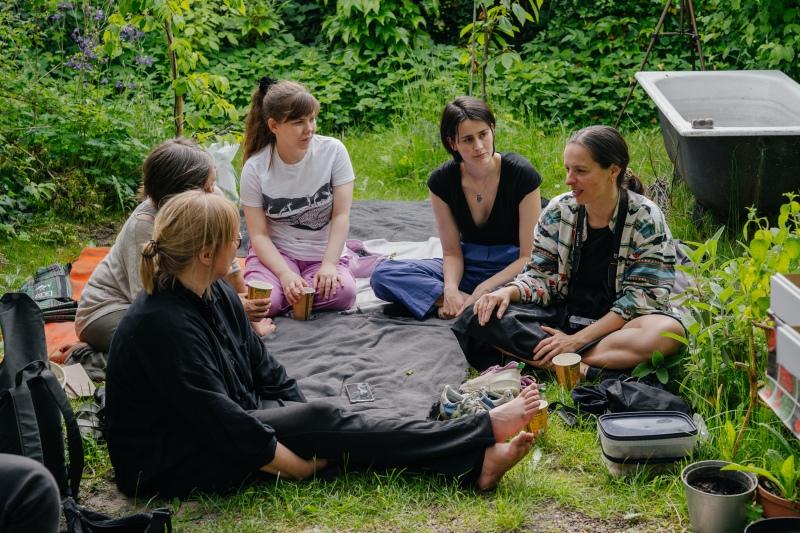
Ola Andrzejewska: Really well. People came over, asked questions and worked side by side – sometimes in silence, sometimes chatting briefly. Shared effort is calming.
Megi Malinowska: Even though I’m a designer, I feel at my best doing physical work – it has a clear beginning and end. During the workshop, little “micro-teams” formed naturally: some people unpacked boxes, others worked with the soil, putting eggshells into holes and planting. Without teamwork, none of it would’ve been possible. There were also some lovely scenes: someone ended up knee-deep in compost, someone else came totally unprepared for working with soil, wearing elegant red shoes.
Ola Andrzejewska: The threshold was very low – you could drop in for a moment and end up staying for hours. Not everything has to be planned down to the last detail. A bit of spontaneity really brings people together.
Mateusz Szymczycha: Here, the meeting itself “carried” the action, without any theatrical self-presentation. Smartly planned work sets a rhythm and lightens the conversation. We started with a short micro-workshop, looking for semantic fields around urban forms of greenery. It was more of a social game than theory – a way to organise and loosen up our thinking before picking up a spade.
So you combined physical work with imagination and language.
Mateusz Szymczycha: Exactly. We thought about letting participants co-design a fragment of the czyżnia, but that would have been too much. So we designed the plant-wall composition in advance. Still, we didn’t want to take away their agency, so we shifted it into a speculative layer – into imagination.
Ola Andrzejewska: This kind of small “deception” can go further. Ecology can work subliminally too – by smuggling in ideas. We had a funny moment in a conversation with the other residents when someone said that the word czyżnia “can’t be translated” and is hard to pronounce. Our workshop was partly about taming wildness, touching thorns without jumping to conclusions.
Mateusz Szymczycha: That’s why the exercises revolved around “wildness” – everyone started from the same word, but went in different directions. We knew the thinking would eventually circle back to czyżnia, but the framework was broad: wildness as a space for many forms of life, not just plants.
Megi Malinowska: During the workshop, twenty people gave “wildness” their own colours, sounds and associations. It wasn’t just about digging holes – we wanted people to see, hear and feel more first. It’s also a way of countering plant blindness. Greenery often becomes just a backdrop; the linguistic warm-up sharpened the senses. It also created a good balance: first thought, then sweat.
When will the process mature and really take shape?
Ola Andrzejewska: The effect will be there once the vegetation thickens into a real barrier. For now, it’s still quite sparse. It was a dry year; some plants were burned by manure, others withered. It’s an experiment – some will die, some will survive. If we look at it non-anthropocentrically, it’s an organism made up of plants, fungi and soil. If two-thirds survive, I’ll call that a success. In two years, it should spread properly, and in three years it should be close to its goal.
Mateusz Szymczycha: For me, the real test of success will be the moment when you can’t push your hand through the thicket from the outside. The length of your arm becomes a test of comfort for creatures looking for shelter.
Where should people look for Czyżnia if they want to visit?
Ola Andrzejewska: In the corner by the embankment. As Megi pointed out, Czyżnia connects the park with the embankment. For now, it’s an incubator – a separate area that still needs time to grow into its role.
Megi Malinowska: Speaking of visitors – there are quite a few hedgehogs in the park. We’ve seen them on the camera trap. Do they use Czyżnia? We don’t know, but we’d like to believe they do. Paweł, the Castle’s ornithologist, has counted 41 species of bird, about half of which nest in the area. We hope Czyżnia will become a refuge for them, and a place to nest.