SQUIR
Anna Pajęcka: You’re a group made up of people with very different creative experiences and backgrounds. How did the collective come about, and who does it bring together?
Pau Woźniczka: SQUIR grew out of the practices of the Queer Movement Academy, a grassroots initiative that’s been running since 2022. The Academy functioned as a kind of laboratory and exchange space for people interested in performance, choreography, movement and somatics – a place “to be together in the body.” Anyone could propose practices, lead sessions, teach. Knowledge wasn’t about expert status, but about what emerges through bodily experience. Out of that network of relationships, our smaller group formed. We started functioning as a more coherent body – for a long time without a name, in a fluid, not fully defined way, somewhere between a collective, a working group and a circle of friends.
Alicja Czyczel: The collective really emerged at the intersection of two communities: the Queer Movement Academy, which Pau mentioned, and Przestrzeń Wspólna (Common Space) – a support group and knowledge-exchange platform for people across Poland working in choreography, contemporary dance and somatics. We got to know each other while working in a larger organisational group on Wielka Księga Scorów (The Great Book of Scores) – a six-month project at Jasna 10, the Krytyka Polityczna Club in Warsaw, in 2023. That process gave us time to get closer and to learn how to work together.
Jagna Nawrocka: SQUIR only became a name and a formal structure when we started working with the Museum of Modern Art in Warsaw. In 2025, the collective consolidated – and almost at the same time, it began to dissolve. Two days ago, we made a joint decision to end our activities in this format.
You mentioned that the collective was formed, in a sense, through an institutional collaboration. In conversations with Common Field residents, the question of how institutions shape collective work often comes up: they offer space, set a rhythm, take some pressure off, but also expose tensions. What did your encounter with the institution at Ujazdowski Castle give you?
Jagna Nawrocka: This is a hard question for us, because it touches on the fragmentation we experienced as an eight-person collective trying to stay together. That turned out to be really difficult. On the one hand, the residency was a huge opportunity – it gave us pay, space and facilities. In a group of eight highly creative people, each with hundreds of ideas, that’s an incredible amount of potential. But on the other hand, the fee we had to split between us didn’t allow for full commitment. You can’t live on PLN 1,500 for two months of work, so many of us had to take on other jobs. That created tension: the opportunity was there, but the ability to fully use it wasn’t. The institution expects one voice, unanimity. More than once, we had to speak as a “collective” before we’d developed tools for shared thinking and discussion. That sped things up – including the difficult processes.
Alicja Czyczel: I wouldn’t say SQUIR was created for institutional reasons. It came out of a shared need to create together. Working with the Museum of Modern Art definitely accelerated the process of naming ourselves, and in our case that kind of external push was sometimes helpful. Collective creation inevitably produces tension, conflict, fulfilment, success, joy and moments of weakness. I’m not interested in thinking about cooperation and collectivity in ways that ignore how hard it is to resist individualism, take responsibility for building community, or unlearn violent modes of (co)operation in culture. At the same time, being honest about what’s actually happening inside collective artistic practices allows us to see how they’re appropriated by the so-called art market, including institutions. Often that works against artists. Sometimes it benefits both sides – institutions and artists.
Ujazdowski Castle hosted us on clear terms that we agreed to from the start. The institution offered accommodation for selected people, access to social spaces, and the option to book the Krukowski Hall for closed and open events. The residency department also organised and invited us to meetings with other resident artists. Given the absurdly high commercial studio rents in Warsaw, access to these resources is, in my view, a decent offer. Taking into account the low fee Jagna mentioned and the resources I’ve just described, each person in the collective made their own decision about how present they wanted to be at the Castle and how much energy they could give to the process.
What did you do during the residency – what topic did you take up, and with what intention or need did you come?
Magda Czech: We’re a group that produces a lot – also on the level of desires. One of the key aims was to create something for a community, including the queer community around the Movement Academy, but not only that. The second aim – and this was particularly hard to realise in the current conditions – was to develop tools to better understand what our collective actually is and how it functions. As a group, we co-created meetings and forms of celebration for people working in the arts, primarily queer people.
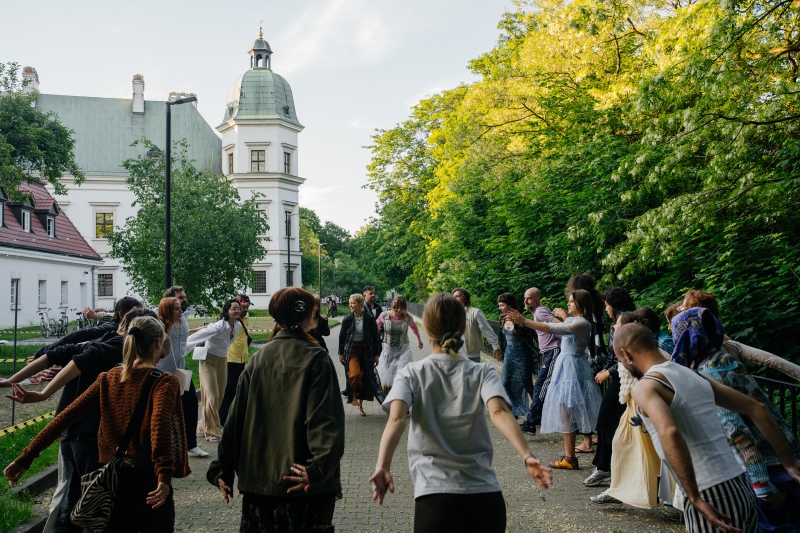
Pau Woźniczka: We organised closed workshops for the community – both in the auditorium and in the garden, where we experimented with different scores and ways of working with the body. The residency culminated in the Ball of Transformation and Change – a several-hour event that came out of a desire to create a space for celebration and togetherness. It was a kind of party, but filtered through questions about how we spend time together, how we can be together in the body, in flow, in creativity, in discovering ourselves “here and now.” The ball started with practices and workshops, then moved into a DJ set, a performatively opened feast and dinner, and finally a collective dance. For me, it was a dream project – an attempt to build a temporary world, a temporary utopian zone where the body and pleasure escape everyday logic and dissolve into poetry, experience, tasting, saliva, sweat, music, euphoria, excess. I feel the whole residency revolved around one question: how to integrate the body, the experience of being together, and the experience of art – both experiencing it and co-creating it. I think of art first and foremost as a space of life, not as a product meant for visual consumption within institutional circulation.
Alicja Czyczel: I came with a need for unproductivity and co-existence. I was rarely at the Castle and worked a lot away from it.
When I look at the documentation of the ball, it’s hard to believe it was a single event. The photos show so many different registers – almost like a whole cycle of activities, from outdoor actions that sometimes feel ritual-like to the dense, performative interior space. Could you say more about this variability?
Jagna Nawrocka: I remember our first tour of the Castle, when Alek Sarna said – half joking, half serious – that we should have a ball there. That joke very quickly became reality, and I feel that reality swallowed us up a bit.
For me, the ball also grew out of an experience of being on the margins. This year was special for us: first we were invited to the Museum of Modern Art, then we were trusted by Ujazdowski, hosted there and supported promotionally. It was extremely moving. Suddenly, we were residents, with almost round-the-clock access to the auditorium, and we could host our community there. That opportunity – significant, but also very temporary – triggered a huge sense of excitement, which for us often leads straight into intense creation. When building the programme of the ball, we worked with the diversity of practices and approaches each of us brings. Our collective body isn’t formed through standardisation, but through exchange – by inviting one another into our individual worlds. These worlds don’t merge into a single line; instead, they start to resonate polyphonically. That polyphony is very characteristic of us.
The ball was meant to be a space of queer utopia – but a utopia with rules. We talked a lot about how genuinely open and safer spaces have their own framework. That’s why we placed so much emphasis on the “prelude” to the ball: a calm introduction to experiences of different qualities of movement, our shared language of embodiment, and tools for working with the body. This included tools related to non-verbal communication. Magda can say more about drawing on the body and about how, in this space, the body was meant to become the primary language, while verbal language became secondary for some.
Magda Czech: I co-led some of the practices before the ball and also co-led the workshops. What stayed with me most strongly was the moment when people encountered something “strange” for the first time – both us as people and the physical practices themselves. For many, it was completely unfamiliar. They could explore, for instance, how much distance they wanted from a particular person, or more generally how close or distant they wanted to be from other people or non-human actors. That was very moving for me. I also remember that some people found it difficult. Suddenly, they were in a space where the focus was strongly on the body – its needs and its possibilities. That required a lot of attentiveness and sensitivity from us.
Alicja Czyczel: During the workshops, ants were crawling over the table and drinking kombucha.
Based on what you’ve said, I’d like to ask about the idea of the “audience”. It feels to me – correct me if I’m wrong – that in your residency practice, both during the ball and the accompanying events, you actually rejected this category. The people who came became participants, invited guests, companions, rather than an “audience”. Is that how you thought about it?
Jagna Nawrocka: Yes, that was our intention. We didn’t want to create an “audience” in the classical, theatrical sense, but to invite people to participate and co-create the space. At the same time, we’re very aware that not everyone wants or is able to participate actively. For some people, it’s safer to witness. We think about trust-building – shaped by experiences of neurodiversity, different sensitivity thresholds, readiness or physical ability – as a spectrum of participation. Being present on the “edges” of an event is just as important to us as being at its centre, and we tried to take that into account very carefully. That said, this is something that needs constant reflection and a critical approach, especially in co-creative practices. We want to create conditions where the centre can be redefined by those who are used to staying on the margins.
Alicja Czyczel: The audience – or rather how people behave and how they feel – changed depending on the format we proposed. We experience things differently when we’re lying in a circle on the grass with strangers, differently during a feast in a dark room, and differently again after an hour of dancing together. From my perspective, the audience has agency, and it’s up to them how they respond to the invitation encoded in the format we propose and what they take from it for themselves.
I’d like to ask about practices of reducing distance – about ways of getting used to being together. You talk about events built on desire, closeness, crossing boundaries, shared ritual, space and bodies. In conversations within Common Field, we often come back to the idea of community, and I’ve been asking residents what practices help to make being together feel familiar, to dissolve the awkwardness of meeting strangers. How does it work for you?
Pau Woźniczka: For us, the key question was what participation and involvement really mean. We stressed this very clearly in the ball’s etiquette and in the email sent to people who signed up: every form of involvement counts as full participation. You can be present at “1%” – sitting on the side, witnessing, observing – and you’re just as important to the group process as someone who’s “100%” involved, intensely and visibly. This was crucial for us, and from what participants told us, that perspective really shifts things. It allows people to understand that there are many ways of being involved, and that these different ways are invited, seen and wanted – not judged.
Jagna Nawrocka: One of our basic strategies is play – both with narrative and with body language, which is rarely taken seriously in public space. At the Castle, we proposed a “baroque swamp” dress code, touched the garden with slime-covered hands in “snail” practices, spun around in an experimental oberek, and pulled silly faces from the observation deck. These are simple gestures that translate our internal language into something shareable – through physical and performative action. For example, we hold a tablecloth together and remember that even a movement made without direct touch affects people far away. It’s like playing in kindergarten. We use a lot of these “kindergarten” games that bring back childlike ways of forming relationships. That’s our language – we’re not afraid of childishness. We return to tools that worked when we were children, and we remind ourselves that as adults we’re still allowed to mess around, to be in a group performance, in a backyard-child mode. This really dissolves boundaries. When something funny happens at the start of an event, people often drop their masks and loosen up. Food is also a big part of being together – sometimes deliberately a bit “disgusting”. It looks odd, you don’t know whether to eat it with your hands or with cutlery. We introduce a lot of controlled cringe: shared embarrassment, laughter, uncertainty. We normalise the fact that this is what life is like – and that it’s good to experience it together.
Alicja Czyczel: For me, reducing distance isn’t as important as creating conditions where people can let go. I remember people at one of the workshops lying together on blankets and cushions on the grass. The sun was out, the trees were in bloom all around us. That was enough. Just let the body lie down and do nothing.