ZAKOLE
Anna Pajęcka: What is ZAKOLE and where did it come from?
Pola Salicka: We are a collective closely tied to a specific place – Zakole Wawerskie, a wetland area in Warsaw. Everything we do, whether artistic, social or educational, is connected with this site: its history and its current socio-political and ecological entanglements. Some projects come straight out of what we observe there; others are rooted in the place more loosely, growing out of our relationships and our experience of being there. We’ve been working for five years now, at the intersection of art, activism, education and cultural practice. We’re looking for alternative forms of education that go beyond institutions and buildings. From the very start, we’ve invited people from various backgrounds to work with us – scientists, artists, humanists and activists.
Formally, there are five of us, but the community around Zakole is much larger. Strengthening those relationships is one of our main goals.
How did the community around Zakole – a wild place in Wawer that you have, in a sense, reintroduced to Warsaw residents – come into being? What did that process look like?
Krysia Jędrzejewska-Szmek: It’s been a long and interesting process, and it’s still ongoing. It takes a lot of attention and flexibility on our part. Zakole used to be linked to farming families, who mainly grew cabbages and cucumbers that were then pickled and sold in Warsaw. When those farming practices disappeared, people’s relationship with the area broke off too. At the same time, from the 1950s onwards, the site was studied by natural scientists – mostly ornithologists and botanists – though this research had very little social impact. When we arrived, the agriculture was gone and the results of the scientific research were known almost exclusively to experts. What’s striking is that people living right next to Zakole often didn’t go there at all. It was seen as inaccessible, wild, even dangerous.
We met people whose parents had once forbidden them to enter Zakole. So we decided to build a community, slowly and gently – not through mass events, but through intimate meetings, shared walks and careful observation. From the beginning, our activities were small-scale. It was only after several years that we started working with families who still own private land there. That took time and trust, especially because their situation is difficult: they can’t sell or build on their land, but the city won’t buy it either.
At the same time, Zakole has something quite unique. People who come there often say they experience a different rhythm, a different way of being in the world. It’s a space that allows you to be different with others, and also with yourself.
How did the neighbours react when you began working there?
Krysia Jędrzejewska-Szmek: Reactions varied a lot. We often came up against distrust from landowners – which is completely understandable. These are people who’ve spent years stuck in a situation where the city blocks development but refuses to buy the land. So when we showed up, wanting to do social or environmental work, it naturally raised suspicions. I think that’s why, during our first years at Zakole, we had no direct contact with them at all. The owners assumed we were “on the other side” of the conflict – that we were acting against their interests by insisting this wasn’t a building site and shouldn’t become a housing estate. Over time, however, we managed to find common ground and build relationships based on mutual trust.
Our everyday encounters on site are very mixed – often surprising and unpredictable. Once we saw a cyclist carrying his bike over his head because, while the map showed a path, in reality that meant wading through dense undergrowth. Some people wander off the beaten track and suddenly find themselves deep in Zakole’s wilderness, only to stumble upon us bent over a tree. These chance encounters often turn into really interesting conversations.
Neighbours often say they know Zakole exists but “don’t know how to get there,” or where the paths are. Very few people know the area well enough to move around freely. And then there are completely unexpected scenes too – like a falconer training her bird there.
How did you meet as a collective?
Pola Salicka: We don’t have a romantic origin story. Before the collective formally took shape, we were working under the umbrella of Krytyka Polityczna, as part of a larger European project on “The right to the city”. Krysia brought Zakole Wawerskie into the project as a place with huge potential. The rest of us joined gradually and we worked within that grant framework for about two years. At some point, the place – and our shared way of working – became so important that we decided to continue as a collective, sometimes independently, sometimes within subsequent projects. For five years now, we’ve had the chance to collaborate on various activities in Poland and abroad. The Common Field residency was especially important for us because, after a very intense period, we needed time to slow down, to be together again and to think about which topics we wanted to develop further.
Was it a kind of respite residency?
Krysia Jędrzejewska-Szmek: It wasn’t a “respite residency” in the sense of not working – we were preparing an exhibition for the MSN [Museum of Modern Art in Warsaw] at the same time – but the conditions were very good. We had a shared studio, regular meetings, a kitchen and a library. We also had a lot of freedom: we were able to experiment and do things mainly for ourselves. That really strengthened our collaboration.
How did you spend time together?
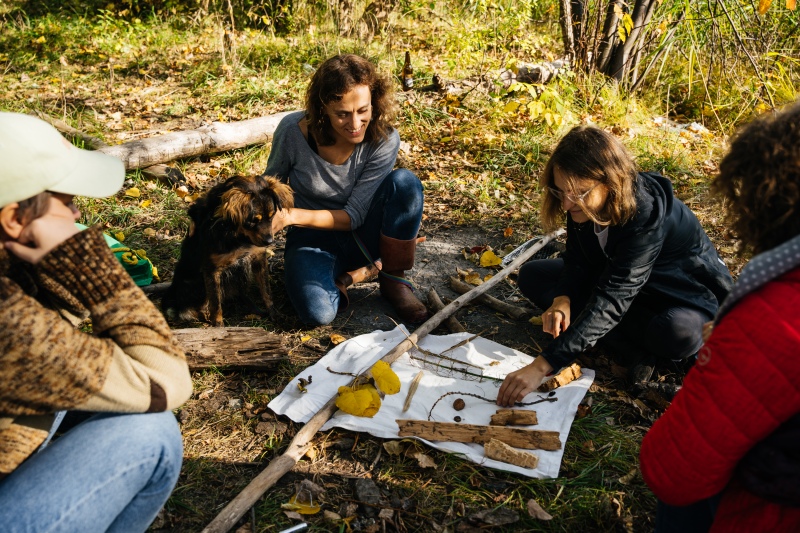
Pola Salicka: We developed a format for reading meetings. It wasn’t entirely new to us – each of us had experience with grassroots reading circles – but we wanted to rethink the format and connect it more directly to the practices we’d developed on site. We organised several internal meetings, starting by identifying thematic areas linked to Zakole. These topics had already been surfacing in our work, but we’d never really had the time to dig into them properly. So we decided who would lead and prepare each session and set up a series of meetings just for the collective. Each one had a different format and took place in a different setting: one was designed as a field game, another happened in the dark and focused on “ghosts”, and for the third we built a shelter-tent in the studio. We held the first meeting at Zakole itself, because we felt strongly that we needed to begin there.
Later on, we continued these themes at the MSN. We ran reading meetings as part of the public programme, with the idea of a “soft base” growing out of the shelter-tent we’d tested in the residency studio and during the event marking the end of the Common Field residency.
You mentioned “internal” meetings. Were they just for you, or did you invite others?
Pola Salicka: They were just for us, as a collective.
Krysia Jędrzejewska-Szmek: And precisely because they were only for us, we had much more freedom to experiment. We treated those internal meetings at Zakole as a research and testing ground before moving on to public events later.
I’m also interested in how institutional frameworks support community-building in small groups. Did the residency show you anything new about working “within an institution”? Did it give you tools or boundaries that turned out to be helpful?
Krysia Jędrzejewska-Szmek: Right from the start – when we were working under the umbrella of Krytyka Polityczna – we saw how crucial institutional support is for collectives. We work in precarious conditions: we split our fees five ways and everyone’s personal dynamics pile up. A residency that didn’t focus on “delivering” public events created space for much bolder experimentation. We didn’t have to take safe, proven positions; we could afford to make mistakes and play around with methods. That’s rare. Even organising a small walk usually demands precision and careful attention to form, but here we could simply explore.
Pola Salicka: I agree. On a practical level, it helped enormously too. Coordinating five calendars is usually almost impossible. During the residency, it was much easier: we knew exactly where and when we were meeting, we had two months and we set our own goals. We didn’t have to produce anything public – only at the very end, together with the other residents, did we organise a joint event.
We did that for two reasons. First, we wanted to test the reading-meeting format in a public context. Second, we wanted to see how our themes resonated with what the others were doing. And that actually reinforced the idea of community – very much in line with the residency’s title, Common Field.
Could you tell me about collective reading as a tool? How does it work and what does it give to the group? If someone wanted to try it out in an association or among friends, why would it be worthwhile?
Krysia Jędrzejewska-Szmek: On one level, it’s about deliberately setting time aside to focus on words – breaking thoughts down into smaller parts and talking them through together. On another, it’s about being together in a mindful way, especially in a world that’s completely saturated with stimuli. That’s why we combine listening with simple manual activities that keep the hands busy and free up the mind. It creates space for slowing down and for deep, collective work.
Pola Salicka: We never aimed to create a closed “methodology”. Instead, we experimented with embodied reading. During the residency, we didn’t discuss texts in a classical, academic way. We tested how the body shapes perception: whether you’re lying down or sitting, whether your eyes are closed, whether you’re reading alone or listening, whether you’re in the dark, indoors or outside. A text resonates with images from memory, including bodily memory. That’s why we intersperse reading and listening together with drawing, modelling or simple movement tasks. We always include rounds for sharing impressions. This really deepens understanding – working with a text does not have to be purely intellectual; it can also be emotional and experiential.
This physicality sounds very open – paying attention to breath, to the body’s micro-reactions. There’s rarely space for that in solitary reading. And in the end, will you share what you read?
Krysia Jędrzejewska-Szmek: We organised the meetings around three main themes: hauntology and reinterpretations of haunted archives; speculations about possible pasts and futures, including cosmologies of a world emerging from water; and multi-species communities and the commons.
Pola Salicka: Within those themes, we read short excerpts from a wide range of texts. These included, for instance, the Haudenosaunee creation story (as referenced by Robin Wall Kimmerer in Braiding Sweetgrass), Ethnobotanical Surveys from the Early 19th Century, and Pleasure Activism, edited by Adrienne Maree Brown.