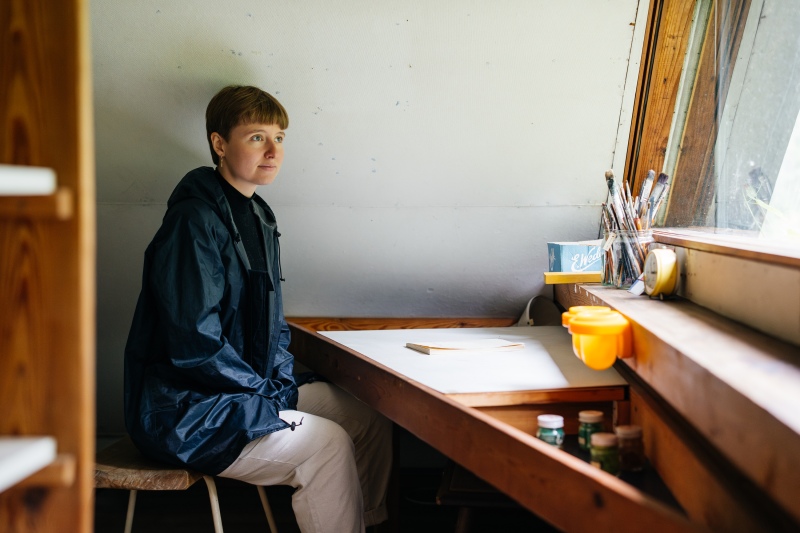
Zuzanna Szymłowska
Let’s start with your point of departure – your studies. You graduated from the design faculty and your practice combines three areas: design, ecology and art. How do they come together? How does design shape your artistic and ecological work?
At university, I learned to think through problem-solving and the methodology built around it. That’s basically the designer’s job: identify a problem and resolve it according to the rules of the discipline. That way of thinking shaped me very deeply, even though I’m now trying to step back from it a bit. I’m actually slightly annoyed by that modernist formatting. In art, you don’t have to solve problems – you can just ask questions and that’s enough.
So art allowed you to step outside this “problem-solving” logic?
Yes. Design often pushes you towards ready-made answers, which can lead to dead ends and to a constant “redesigning” of the problem or the space itself. That produces excess and waste, reinforcing the logic of growth and constant production. In art, I can allow things to stay open, without forcing a solution. When I started the residency, I was still working very much within a design mindset – defining the problem. Only during the process did I realise I could simply observe and share those observations with others. I didn’t have to solve anything. That was truly liberating.
And how did ecology enter your practice?
It started very simply. While I was writing my bachelor’s thesis at the Faculty of Design – in 2023 or early 2024 – I thought the best approach would be to connect it to something I genuinely cared about. At that point, I was becoming fascinated by birds and urban ecology. I was interested in how nature functions in the city, how the boundaries between architecture and plant structures blur, and how beavers, mergansers and wild boars move through urban space. Ecofeminist and artistic themes came later. At first, it was mainly about being in nature and about activism. I read Professor Marta Szulkin’s research on bird welfare in cities – on how birds overheat in nest boxes installed by people in urban heat islands. I started asking myself what I could do about this as a designer. I followed new projects and initiatives, did some guerrilla gardening with friends (greetings to guerrilla gardener Andrzej), and attended ornithological club meetings. It was a slow radicalisation towards fairer forms of coexistence – both within the city and with nature.
Did you come to the residency with a ready-made idea?
Yes. I wanted to identify a space in the park around the Castle that could be taken out of human use and handed over to non-human beings – left to develop on its own, so ecological succession could happen naturally. That was the project. Very quickly it became clear that it was more important to observe what was already happening there on its own.
And is that what led you to the escarpment? You know, I experience the escarpment through everyday struggle, because I live right at its foot.
The Warsaw Escarpment – or at least the section near the Castle – is already a space taken out of human use. It also doesn’t provide any “ecosystem services”, as designers and officials like to put it. It sits somewhere on the margins, more like a backdrop to the daily commute than a destination. It’s neither a park, nor a leisure space, nor a clear hotspot of biodiversity. What’s fascinating is watching what happens when humans withdraw, while at the same time piercing the space with their presence from every direction – both historically and today. The escarpment has long been dug up, drained, planted with trees, bombarded, filled with rubble and flooded with noise pollution. I started wondering whether this idea of letting succession in urban spaces happen completely spontaneously – just letting things unfold – could be “re-engineered” elsewhere in the city. Would that actually be beneficial? And is it even necessary? Over time, it became clear that this land, and the park itself, needs care and support, not simply abandonment. Our actions are part of the urban ecosystem too – just as much as those of insects, small mammals or plants.
So ecology isn’t only about “not touching”, but also about “caring”?
Yes. Another important question for me was how we, as humans, actually feel in spaces like this. I was looking for ways of being together there – on terms different from those we usually bring into a park or a nature reserve.
I know you organised walks along the escarpment. What did you gain from encountering the site as a group?
I think it gave me a strong sense that wasteland demands a lot of work from us as city dwellers. We need to unlearn our assumptions about how urban public space should look, how we’re supposed to interact with it, and how to listen to it. In short, how to respect wasteland. Maybe I also allowed myself to accept that such places can remain mysterious. Of course, someone still needs to take care of them and retain knowledge about them. At Ujazdowski Castle, there are people who know which birds nest in the hollows of the escarpment’s trees, which plants and fungi grow there. I began the walks by reading an excerpt from Gilles Clément’s text on what he called the “third landscape” – spaces excluded from power and hierarchy, not governed by the logic of productivity. That idea really moved me, because in cities, greenery is almost always talked about in terms of usefulness: that it “provides” something, that it serves a function, that it’s a resource. Clément shows that there are spaces that simply exist, outside of this regime. Realising how political that is was very important to me. During the residency, I also had time to read and look at the work of earlier residents. Milena Bonilla is one of the artists who deals brilliantly with the political entanglements of nature. I find her work incredibly inspiring.
So the walks were a way of sharing this experience?
Yes. We made observations during the walks, looking at the space from different angles, trying to notice its otherness and confront the discomfort it can provoke. The goal was not to “tame” nature, but to find comfort in what is untamed, wild, mouldy and decaying. Because that’s exactly what the escarpment is like – and that’s precisely what makes it beautiful. Walking is simple: it gives you movement, direction and momentum. But during our walks we also sat down and just stayed. And that kind of “static being” turned out to be surprisingly difficult. I called it “static drift” – an attempt to unlock this way of being present.
You use the terms “ecological drifting” and “biotic presence”. What do they mean?
I took “drifting” from the Situationist tradition, where it referred to the city and to discovering its structures through walking. I wanted to transfer that idea to a space that’s “non-urban, yet still urban” – the escarpment. Because it is still the city: you hear the noise, feel the movement, but at the same time nature is right there. I find that really fascinating.
So “ecological drifting” is a way of being in urban nature?
Yes – and one where you try to minimise your presence. Not to impose yourself on the space, but to let it guide you. And to accept that you’re not in a forest, a park or a nature reserve – you’re in a place where the city and nature are tightly intertwined.
And “biotic presence”?
“Biotic” refers to what’s alive. “Abiotic” is what doesn’t support life. In the city, an abiotic space might be a concrete square exposed to full sun, with no shade and no moisture – a place where almost nothing can take hold.
So could we say that a museum, in its imagined, ideal form, is an abiotic space?
I guess so. The white cube is usually sterile, cool, cut off from life. A lot of contemporary museums actually aim for that – creating a microcosm detached from the world, where nothing happens except for the “contemplation of art”. The current exhibition at Ujazdowski Castle – Soil and Friends – breaks with that model. The gallery walls are covered with pigments made from fermented plants collected in the surrounding area, and the artworks spill outside – into the weedy fields around the Castle and onto the trees.
That’s especially interesting in the context of the Castle, which works almost as an inverted space, deeply entangled with the living nature around it. I know you worked with bee houses there, for example.
Yes, that was a commission from the Green Team from the Ujazdowski Castle. They were researching the park’s “biotic health” – commissioning soil tests, consulting dendrologists about tree health, and working with naturalists. In one of those conversations, the issue of caring for wild bees came up, especially species that nest in the ground. We designed three prototype habitats for them and placed them in different parts of the park.
Are they working?
The one under the linden tree has been most sought after – most of the drilled holes are already occupied. Now we want to check which species have moved in and whether the locations are really suitable. The project is modular: if one box turns out to work better in terms of colonisation, we’ll move the others and see what happens. Ideally, we’d just sit by the entrances and… wait for the bees to fly out.
Were bees part of your practice before this?
Yes. In my bachelor’s project, I worked with clay mixtures – clay, sand and chaff. I was interested in what might inhabit them and how such materials could function in urban architecture. Insects were one of the threads that naturally came back in the bee project.
I note moments of “science and technology” in your work. Where does art come in?
Combining ecology with design can very easily push things into a purely pragmatic mode. But I’m not only interested in data or in implementing certain assumptions. I’m also concerned with repairing the damaged relationship between humans and non-human organisms, and with critically examining the narratives we produce as a society – about birds, plants, soil and organic matter. That’s where artistic tools are needed. For resistance, for questioning, for pushing back against hierarchies of what’s considered worthy of care and what isn’t. Art makes that possible. It allows us to challenge scientific consensus with intuition – with experience, doubt and radical care. That’s why, alongside project-based work, the conversations, lectures and meetings initiated by Ujazdowski around the Czyżnia created during the residency by the SAM Rozkwit collective are so important. After the residency, I also joined the Chwaściarnia collective – a group of herbalists and artists founded by Julia Krupa, currently made up of Marianna Łupina, Anna Nowakowska, Anna Kamecka and Martyna Chmielnicka, with a few less active members. Through foraging, we talk about plants and the stories that have grown around them. Our activities include field trips, mindfulness practices and sharing knowledge.
Foraging often raises ethical concerns today, since it’s easy to interfere with protected ecosystems.
In the Chwaściarnia approach, foraging is understood as a practice with a long tradition – using what grows around you and knowing how, where and when to do it. It’s not just about collecting plants, but also about collecting stories. During one workshop I ran with Marianna Łupina, my mum told us – and the other participants – a story about curly dock, which is used for stomach problems. It was the first time I’d ever heard that she knew this plant, and that her grandmother had used it.
So, to sum up: design gives you tools, ecology gives you sensitivity and material, and art gives you space to ask questions instead of seek answers?
Exactly. And what’s more, art makes it possible to come back to the body. Biotic presence isn’t a metaphor. It’s about actually being somewhere: discomfort, cold, smells, the rustling of leaves, the sting of nettles, snail slime, the cawing of crows…
There’s a phrase I associate with your work: “letting go”. It comes to mind when I think about what you do. How do you understand it?
As a conscious stepping away from the urge to “solve the problem”. Allowing yourself, first of all, to be – to listen, to look. For me, the residency was largely about letting go. And that turned out to be deeply creative.