Waterbottles x 8 (1994/2026)
One-day presentation of a work from the Ujazdowski Castle Centre for Contemporary Art Collection, with the artist
-
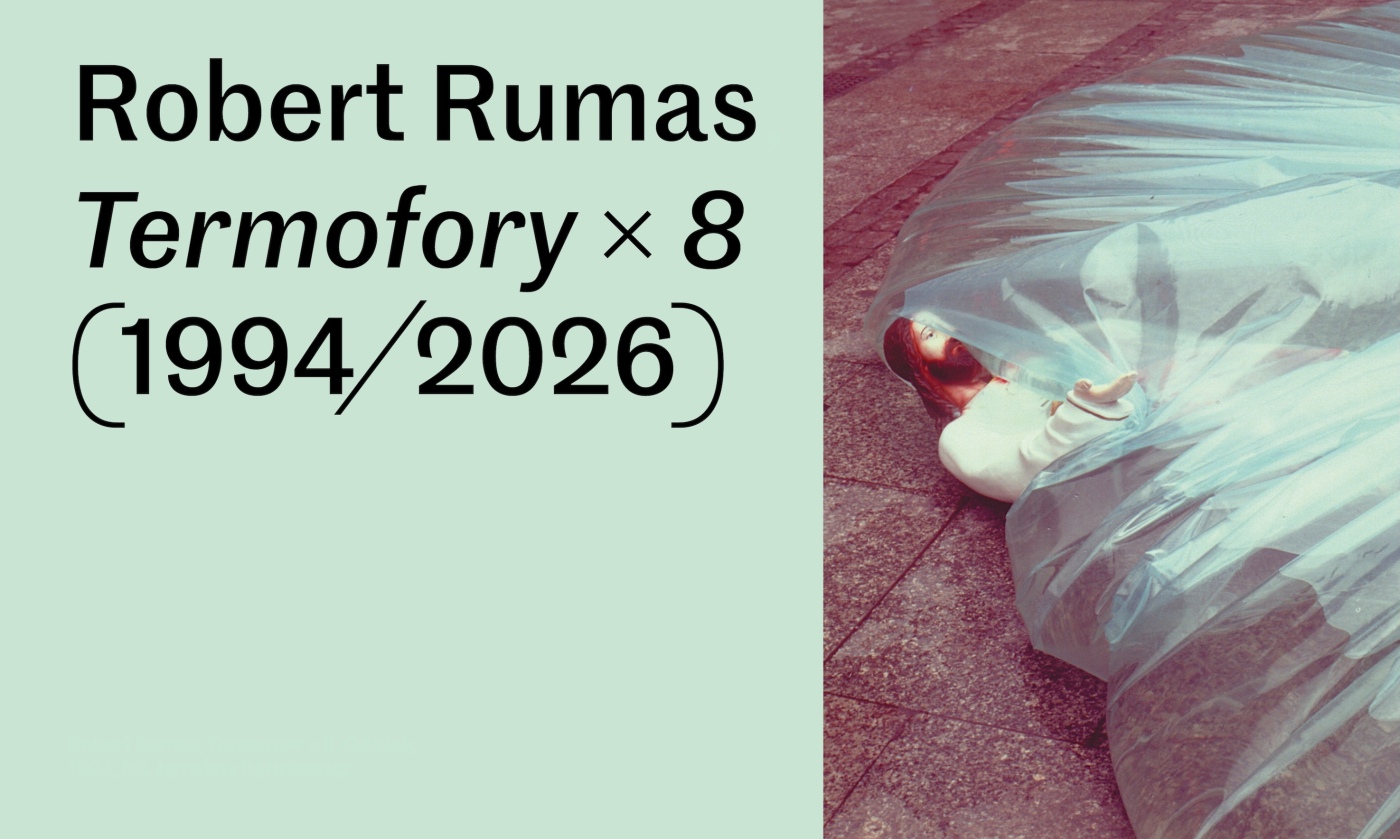
Termofory × 8 (1994) by Robert Rumas occupies a significant place in the recent history of Polish art. Both its content and form, as well as the circumstances of its presentation in public space, make it a singular work, without any clear equivalent among artworks produced at the time. Its acquisition by the collection of the Ujazdowski Castle Centre for Contemporary Art and its re-presentation, prepared in collaboration with the artist in front of Ujazdowski Castle on 25 June 2026, testify to the continued relevance of the issues addressed in this work and, more broadly, throughout Rumas's artistic practice of the 1990s.
-
Termofory × 8 was originally realised as part of the International Multimedia Workshops Project Wyspa, organised in Gdańsk in 1994. It was first presented in the city's Long Market, adjacent to Neptune's Fountain and Artus Court. The event proved pioneering in shaping a new artistic language and introducing themes that preoccupied a younger generation of artists emerging in the early 1990s. As Ewa Mikina observed: "Gdańsk's Project Wyspa is the first significant attempt in this country to develop a fundamentally different mode of artistic thinking. Rather than pursuing the transgressive and alternative poetics characteristic of the historical avant-garde, the artists of Wyspa propose an open discussion of urban issues that, in fact, concern us all." [1] Against this backdrop, Rumas's intervention appears particularly compelling. By intervening in the symbolic space of central Gdańsk, the work raised questions about the relationship between art, everyday life, and the social experience of its audience.
-
-
In 2001, Termofory × 8 was presented again in Brussels' Grand-Place as part of the exhibition Irreligia. Morphology of the Non-Sacred in Polish Art. Despite their brief duration, both presentations—one in Poland and the other abroad—generated considerable public response that extended well beyond the sphere of contemporary art. Rumas's work became the catalyst for a broader debate on the limits of artistic freedom of expression, the place of art in shared public space, and the principles governing a democratic society. The debates surrounding Termofory × 8 also addressed the presence and equal standing of different systems of values in the public sphere, including the right of religious and secular forms of expression to coexist and to occupy spaces accessible to all citizens. In this sense, the work resonated not only as a piece of contemporary art but also as a catalyst for reflection on ideological pluralism and the role of art within public discourse.
-
Termofory × 8 adopts the visual language of multiplied large-scale sculpture constructed from impermanent materials—primarily water and transparent plastic. Large plastic bags filled with clear water were placed directly on the ground, outside the "art bubble", in a non-gallery, non-museum setting accessible to everyone using the urban environment, including residents, passers-by and tourists. Beneath the titular hot water bottles—objects literally intended to provide warmth and aid healing—the artist placed two figurines depicting Christ and the Virgin Mary. Rumas purchased both devotional figures from religious goods shops. They had never acquired the status of sacred objects, as they had never been blessed. Nor had they ever served as objects of worship or devotion. They nevertheless functioned as unmistakable carriers of religious imagery and symbolism.
-
-
At the heart of Termofory × 8 lies a reflection on Polish Catholicism and the condition of religious belief. The work focuses on the superficiality with which Catholicism is often experienced, condensed in the mass-produced representations of Christ and the Virgin Mary. Of particular importance is the artist's use of the hot water bottle—a commonplace and universally recognisable domestic object—which he invests with symbolic and social significance. Associated with warmth, care and relief from discomfort, it is displaced from the private sphere into public space, where it becomes a sign referring to collective experiences and the need for social "healing". The work thus articulates the tension between the individual and the intimate on the one hand, and the communal and the public on the other.
-
The liberation from norms and patterns of behaviour shaped by religion—while simultaneously restricting the individual, including the artist himself—is presented not merely as a therapeutic act. Rather, Rumas develops a critical discourse directed both at the culture in which he operates and at the role of the Church as one of the institutions shaping Poland's social and symbolic order. The work's impact, resulting from the juxtaposition of its constituent elements, the presentation of the sacred figures in a recumbent position, and the very gesture of employing ready-made devotional figurines, led Termofory × 8 to be perceived during its presentation in Gdańsk as a work capable of offending religious sensibilities.
-
-
Within minutes of its inauguration, the work was destroyed by members of the public. The water-filled plastic bags were punctured, while the figures were carried to the diocesan curia of St Mary's Basilica in Gdańsk. An article by Aleksandra Krasucka published in Dziennik Bałtycki [2] warned readers of the "blasphemous hot water bottles", describing the work as an act of profanation and brazen provocation. Public reactions centred primarily on the perceived inappropriateness of placing figures of sacred personages directly on the paving stones. A similar situation occurred several years later in Belgium, where the work was once again destroyed during its presentation in the square in front of Brussels Town Hall. Over time, despite the ephemerality inherent in the work's short-lived action and fragile materiality, Termofory × 8 came to be recognised as one of the iconic works of Polish critical art of the 1990s.
-
Piotr Piotrowski identified Robert Rumas as one of a small group of visual artists who, after 1989, consistently engaged with the question of Catholicism while developing a critical language through which to address the Church's social and political role. [3] Within Rumas's broader body of work, Termofory × 8 stands out as one of its most significant realisations, articulating with exceptional force the latent conflicts embedded in the relationship between the Church, the state and society during Poland's post-socialist transformation. Stanisław Ruksza likewise emphasised the work's critical importance, describing it as "the first artistic intervention after 1989 to reveal the potential for conflict within Polish public space, above all at the intersection of the state and the Church." [4] Agnieszka Sural, in turn, included it among the eleven artworks that generated the most significant controversies in Polish art after 1989. [5] Such assessments suggest that Rumas's work not only accurately diagnosed the tensions characteristic of the transformation period but also anticipated conflicts that would become central to public debate in the decades that followed.
-
-
The most comprehensive interpretation of Termofory × 8 was offered by Ewa Mikina. She examined the work in relation to civil rights, art in public space, and the destructive "reaction of the street." [6] At the same time, she argued that contemporary art had become increasingly responsive to social issues, while conceptions of freedom understood primarily as individual artistic expression were gradually being displaced by questions concerning repression and privilege.
-
More than three decades after the realisation of Termofory × 8, the tensions it exposed remain largely unresolved. The work itself has lost none of its relevance in the context of persistent ideological polarisation and ongoing disputes over the limits of freedom in public space, where the position of the Church—and of a single dominant religion, often reduced to superficial rituals and symbolic gestures—continues to play a significant role. Rather than closing off possible interpretations of Termofory × 8, the persistence of these tensions confirms that public space, art, and the freedom of self-determination remain sites of continuous negotiation over values and meaning. The acquisition of Robert Rumas's work by the collection of the Ujazdowski Castle Centre for Contemporary Art—one of the key institutions responsible for the development and presentation of Polish critical art of the 1990s—further reinforces this perspective.
-
-
On the evening of 25 June 2026, at approximately 8:00 pm, during the presentation of Termofory × 8, a visitor to the Ujazdowski Castle Centre for Contemporary Art approached a member of staff to ask about Robert Rumas's work, suggesting that the figure of Christ should not be lying on the ground. Moments later, he intervened in the artwork by "freeing" the figure from beneath the water-filled hot water bottle, carrying it into the museum's main hall and placing it on a windowsill. The entire action, carried out silently and with evident concentration, while leaving the figure of the Virgin Mary untouched, took no more than a few seconds. The "unwritten script" had once again come to pass, with one crucial difference: this time the figure found refuge not in the house of God, but in the "temple of art", where it will remain as part of the museum's permanent collection.
-
Michał Jachuła
June 2026 -
-
- [1] Ewa Mikina, ‘Przestrzeń publiczna’, Magazyn Sztuki, no. 5 (1995), pp. 238–245, reprinted in Słów brak. Teksty z lat 1991–2012, selected and ed. by Marysia Lewandowska and Jakub Gawkowski (Poznań–Łódź: Galeria Miejska Arsenał and Muzeum Sztuki w Łodzi, 023), p. 29.
- [2] Aleksandra Krasucka, ‘Bluźniercze termofory’, Dziennik Bałtycki, no. 136 (14 June 1994).
- [3] Piotr Piotrowski, Znaczenia modernizmu. W stronę historii sztuki polskiej po 1945 roku (Poznań: Dom Wydawniczy Rebis, 1999), p. 236.
- [4] Stanisław Ruksza, ‘Robert Rumas, Termofory × 8, Gdańsk 1994, installation’, Sztuka Publiczna, https://sztukapubliczna.pl/pl/termofory-x-8-robert-rumas/czytaj/102 (accessed 9 June 2026).
- [5] Agnieszka Sural, ‘Największe skandale polskiej sztuki’, Culture.pl, https://culture.pl/pl/artykul/najwieksze-skandale-polskiej-sztuki (accessed 9 June 2026).
- [6] Ewa Mikina, ‘Przestrzeń publiczna’, Magazyn Sztuki, no. 5 (1995), pp. 238–245, reprinted in Słów brak. Teksty z lat 1991–2012, selected and ed. by Marysia Lewandowska and Jakub Gawkowski (Poznań–Łódź: Galeria Miejska Arsenał and Muzeum Sztuki w Łodzi, 2023), p. 24.


