How To Tell When Things Are Off
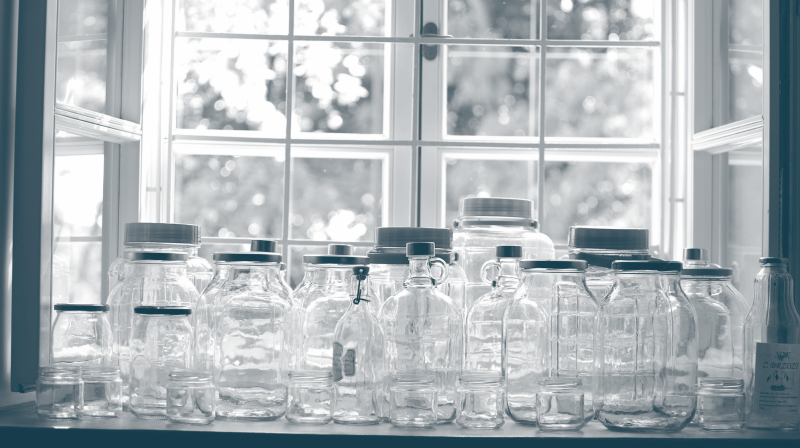
The artist's jars are on the counter, and she is watching, waiting, and wondering when they'll be done. Are they ok? Some of them hold a fizzy fermentation, showing through the glass. Others show no signs of life. It is during this waiting time that things can go a little sideways. Only the artist's senses will tell her if things are off. She must listen to, look at, taste, smell, touch, and feel her ferment. Trusting her senses has led her through the toughest moments of doubt. Even with the most tried-and-trusted recipes, she must rely on those senses to read the signs of microbial life inside her jars and register them in her body as physical memories of experience, embodied knowledge that will guide her through the journey. Some jars are a joy to watch: they bubble, offering a pleasing effervescence. They are extroverted in nature and need to let the artist know that something is happening, that they are working. Other jars are more introverted; they are quiet and work hard without letting her see or hear what they are up to. In turn, the artist needs to understand the nature of her ferments and to accept them.
The artist's nose is the first to tell her what a ferment is up to. If it has a sour, pickly smell, that is a clue that things have acidified and that transformation is underway. If the smell is not only pungent but bad, like rotting potatoes or compost, then the ferment is up to no good. Her eyes will see things that are off-color or otherwise unappealing. She has to monitor the brine's color and its changes over time. Green vegetables will wash out or turn a dull olive color; cabbage and onions will look a little translucent; purple or red radishes will lose their color to the brine; carrots and red peppers, which have oil-soluble pigments and will not change color, might smell and taste acidic. The artist might see a layer floating atop the ferment; it may be yeast, foam, or mold. A white layer is not alarming; it simply indicates that the top layer has been exposed to oxygen, and that next time the artist needs to make sure that her vegetables are totally submerged in brine. Underneath, the wonderful flavors of the ferment will still be intact. If the layer has a yellow or a darker fungal color, then it is always safer to toss the ferment away. Her mouth will read the texture under her teeth; if it feels soft or slimy, the artist's survival instinct will signal to her not to eat it, and if she does, it will feel and taste wrong, and she will probably spit it out. Her gut feeling is another clue to pick up on, but that is another, longer story.
Taste also helps her decide when to stop the fermentation, depending on whether she would like the pickles to be more crisp, more sour, less sweet, or more salty. It takes the probiotics a moon cycle of 28 days to mature, but she may choose to open the jar after only two weeks for a crisper vegetable, but never during the first week (unless she is fermenting fruits), as bad bacteria will still be in control at that stage.
Expanding her body to include the bodies of her jars is what made the artist a bold and playful fermenter. She would pick vegetables and fruits at the end of their seasons, prolong their lives, and alter their flavors. She would read their monthly and seasonal cycles, the temperature, and how climate affects the sugars in the vegetables, and decide how much salt and time are needed to protect her jars. Fermentation is a perpetual state of transformation and becoming, similar to the artist's body with its hormonal changes, irregularities, intrusions, and unpredictability. The artist's body is her site for sense-making and cultivating knowledge. There is no set recipe for that. The knowledge of making a pickle is not only in her mind, but in her hands, her eyes, her mouth, and her nose. It was only then, when she let knowledge live in and on her body, that she was able to distinguish mold from age spots, to let go, and to forgive herself for when things had gone off or had become too sour.
Makdous (pickled and stuffed aubergines)
Ingredients:
1 kg small aubergines
Filling:
5 cloves garlic, with a pinch of salt
1 cup walnuts
1 cup freshly grilled red peppers (ideally a mix of sweet and hot)
salt to taste
Method:
-
Wash the eggplants and cook them in boiling water, on a low heat, for about 5 minutes until slightly soft. Make sure to not overcook them, if you do they will fall apart during the fermentation process.
-
After the eggplants are boiled, you will need to remove as much water from them as possible.
To do this, make a small incision in each of the eggplants and rub 1/4 teaspoon of salt in the opening. Then position them in a colander with the cut down and put some weight on top, leaving them overnight. -
Prepare the stuffing. Crush the garlic with a bit of salt, mash the grilled peppers and chop the walnuts. Mix all the ingredients together, they need to form a chunky paste.
-
Take the salted eggplants and drain the excess water. Make some space inside the eggplants and stuff them with the prepared paste. Be generous with the stuffing, and try to close the eggplants, so that the stuffing doesn't fall out.
-
Arrange the stuffed eggplants in a colander and put them under pressure overnight again, so that even more excess water comes out.
-
The next day, stack the eggplants in a jar as tightly as possible. Add some weights on top if necessary.
-
Pour equal amounts of olive oil and a neutral oil (sunflower, corn, canola, etc.) on top, until the eggplants are completely submerged
-
Keep checking on your jar for the next two days and add. more olive oil if necessary. The eggplants need to be submerged in the oil entirely and at all times.
-
Leave to ferment at room temperature for one month. During the first two weeks the ferment will be more extroverted, and the eggplant will even have a fizz that will be felt on the tongue. After that period the fermentation will slow down and the activity of the bacteria will be calmer. Make sure to keep the jar in the fridge after opening.